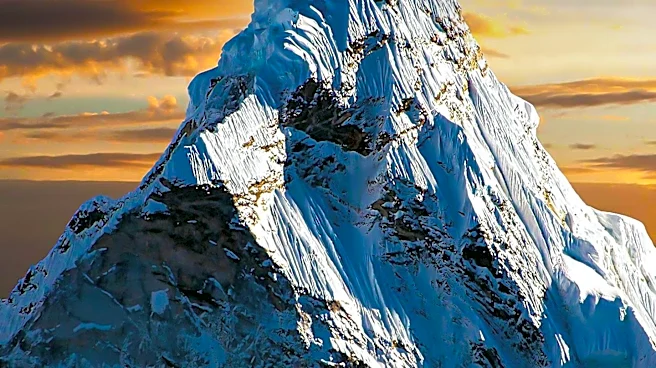









Mount Everest, the world's highest mountain, draws countless climbers, from seasoned mountaineers to those seeking the ultimate challenge. While not always presenting extreme technical climbing difficulties on its standard routes, the mountain is fraught with significant dangers. Beyond the inherent risks of high-altitude mountaineering, the increasing popularity of Everest expeditions has brought environmental challenges, particularly concerning
the stability of its base camps. Understanding these aspects is crucial for anyone contemplating an ascent or studying the impact of human activity on this majestic peak.
Climbing Routes and Inherent Dangers
There are two primary climbing routes to Mount Everest's summit: the standard route from the southeast in Nepal and the route from the north in China. The southeast route is generally considered the standard. Despite the perception of Everest as the ultimate climbing test, the standard route does not pose substantial technical climbing challenges in the same way some other peaks might. However, the mountain presents a unique set of dangers that have claimed many lives. These include altitude sickness, which can be debilitating or fatal, unpredictable weather patterns, and powerful winds that can reach speeds of 160 km/h (100 mph) or even 280 km/h (175 mph), as recorded in February 2004. These winds can blow climbers into chasms and, due to Bernoulli's principle, can lower air pressure, reducing available oxygen by up to 14 percent.Other significant hazards include avalanches and the treacherous Khumbu Icefall on the Nepalese side. As of May 2024, 340 people have died on Everest, with over 200 bodies remaining on the mountain due to the dangerous conditions that prevent their removal. Climbers typically aim for a 7- to 10-day window in the spring and fall, when the Asian monsoon season is either beginning or ending, to avoid the harshest winds. While the summit was first reached in 1953, it remained a difficult climb for decades, with only about 200 people summitting by 1987. The commercial era of climbing began in the 1990s, leading to a significant increase in ascents. By the end of 2010, there had been 5,104 summits by about 3,142 individuals, with 77 percent occurring since 2000. This surge in popularity has led to bottlenecks on the routes, as seen on May 23, 2010, when 169 climbers reached the summit in a single day, surpassing the total summits from 1953 to 1983.
Base Camps and Acclimatization
Climbers typically begin their ascent from base camps located above 5,000 m (16,404 ft). On the Tibetan side, most climbers drive directly to the North Base Camp. On the Nepalese side, climbers usually fly into Kathmandu, then Lukla, and trek to the South Base Camp. The trek from Lukla to the summit involves an elevation gain of about 6,000 m (20,000 ft). The South Base Camp, at an elevation of 5,364 m (17,598 ft), is a popular trekking destination, attracting about 40,000 people annually. Supplies are transported to the South Base Camp by porters and yaks, as there are no roads from Kathmandu to Lukla.Climbers typically rest at base camp for several days for acclimatization, a crucial process to reduce the risk of altitude sickness. The trek to South Base Camp from Lukla involves several stages, including a two-day trek to Namche Bazaar (3,440 m or 11,290 ft) for acclimatization, followed by another two days to Dingboche (4,260 m or 13,980 ft) for further acclimatization, and then two more days to Everest Base Camp via Gorakshep. The base camps are rudimentary campsites, but the South Base Camp includes a field hospital and a heliport.
Environmental Impact and Future of Base Camps
The Khumbu Glacier, where the South Base Camp is located, is rapidly thinning and destabilizing due to climate change, making it increasingly unsafe for climbers. In response to this, a committee formed by Nepal's government recommended moving the base camp to a lower altitude. This move would mean a longer distance for climbers between the base camp and Camp 1. While officials initially suggested a move by 2024, resistance from the climbing and Sherpa communities has put the plan on hold, partly because there is no viable alternative location that would allow climbers to pass through the icefall in the safer early morning hours. This highlights the complex interplay between environmental changes, climbing logistics, and the traditions of the local communities.Weather stations play a vital role in monitoring conditions on Everest. The Balcony Station, located at about 8,430 meters (27,660 ft), is the highest weather station on the planet, set up in 2019 by climate scientists Tom Matthews and Baker Perry. Another solar-powered weather station on the South Col went online in 2008, part of the Stations at High Altitude for Research on the Environment (SHARE) project, which also established the Mount Everest webcam in 2011. These stations provide critical data for understanding the mountain's extreme weather and the broader impacts of climate change.