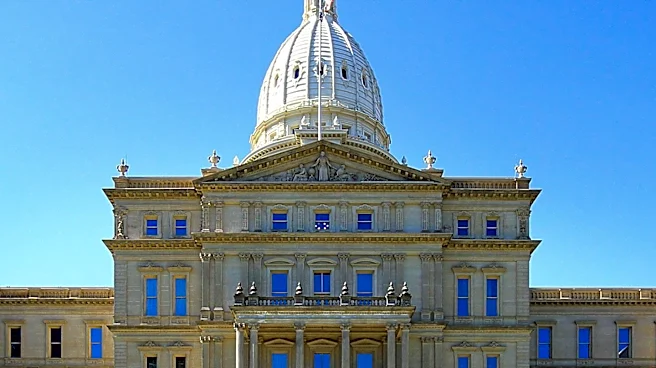




Michigan's history is a compelling narrative of territorial claims, indigenous interactions, and rapid industrialization that transformed it into a pivotal U.S. state. From its early days as a French fur-trading outpost to its eventual admission as the 26th state, Michigan's development was marked by strategic importance and significant demographic shifts. This journey culminated in the 20th century with its emergence as the undisputed center of the U.S. automotive
industry, a legacy that continues to define its economic and cultural landscape.
Early European Claims and Territorial Disputes
In the 17th century, French explorers laid claim to the area that would become Michigan, establishing forts and settlements. These early European presences, such as Fort Pontchartrain in Detroit, were primarily focused on controlling the lucrative fur trade. Detroit quickly grew into a major fur-trading and shipping post, becoming the largest city between Montreal and New Orleans by 1765. French settlers also established small farms, often near Jesuit missions and Huron villages, indicating early interactions and sometimes conflicts with indigenous tribes like the Ojibwe, Odawa, Potawatomi, and Wyandot.
Following France's defeat in the French and Indian War in 1762, the area came under British control. However, control remained disputed, particularly with Indigenous tribes, until treaties between 1795 and 1842. During the American Revolutionary War, Detroit served as an important British supply center. Despite the 1783 Treaty of Paris, which formally ended the war, the British retained control of Detroit and Michigan due to imprecise cartography and unclear language regarding boundaries. It wasn't until the 1794 Jay Treaty that Britain withdrew from Detroit and Michilimackinac in 1796. The area was then part of the larger Northwest Territory, and the Michigan Territory was officially organized in 1805, with Detroit as its territorial capital.
The Path to Statehood and Early Growth
The population of the Michigan Territory grew slowly until a pivotal event in 1825: the opening of the Erie Canal. This new route connected the Great Lakes to the Hudson River and New York City, attracting a large influx of settlers. These newcomers worked as farmers, lumbermen, shipbuilders, and merchants, shipping out grain, lumber, and iron ore. By the 1830s, Michigan's population had reached 30,000 residents, exceeding the minimum requirement for statehood.
A constitutional convention was held, and in October 1835, the people approved the constitution, forming a state government. However, congressional recognition was delayed due to a boundary dispute with Ohio, known as the Toledo War. Congress ultimately awarded the "Toledo Strip" to Ohio, but Michigan received the western part of the Upper Peninsula as a concession. This concession proved incredibly valuable, as the Upper Peninsula became a rich source of lumber, iron, and copper. Michigan formally entered the Union as a free state on January 26, 1837, becoming the 26th state. The state quickly developed into an industrial and trade hub, attracting European immigrants, particularly from Finland, Macedonia, and the Netherlands.
The Rise of the Automotive Industry and Modern Economy
By the early 20th century, Michigan became widely known as the center of the U.S. automotive industry, which developed into a major national economic force. It is home to the country's three major automobile companies, all headquartered in Metro Detroit. The auto industry created numerous jobs in Detroit, attracting immigrants from Europe and migrants from across the United States, including both Black and white individuals from the rural South. By 1920, Detroit was the fourth-largest city in the U.S., with over 30 languages spoken in its public schools, reflecting its diverse urban culture.
Michigan's manufacturing prowess was further demonstrated during World War II, when it converted much of its industry to satisfy defense needs, manufacturing 10.9% of the United States' military armaments, ranking second among the 48 states. While the state faced challenges in the late 1970s and early 1980s due to increasing fuel costs and global competition, leading to a loss of manufacturing jobs and population, Michigan has since diversified its economy. Today, it boasts a gross state product of $754.308 billion as of Q1 2026, ranking 14th among the 50 states. The Lower Peninsula remains a center of manufacturing, forestry, agriculture, services, and high-tech industry, while the Grand Rapids metropolitan area in Western Michigan has emerged as the state's fastest-growing metro area, with a significant presence in the furniture industry and other major companies like Steelcase, Amway, and Meijer.