





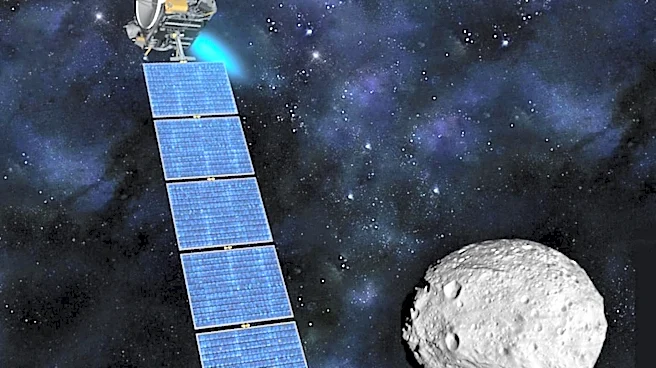


The Psyche spacecraft represents a groundbreaking endeavor in space exploration, designed to investigate the metallic asteroid 16 Psyche. This mission, a collaborative effort between NASA's Jet Propulsion Laboratory, SSL (formerly Space Systems/Loral), and Arizona State University, aims to provide unprecedented insights into a celestial body believed to be the exposed iron core of a protoplanet. Equipped with advanced scientific instruments and powered
by solar electric propulsion, Psyche is set to arrive at its target in August 2029, embarking on a detailed study that could redefine our understanding of planetary formation.
Crafting the Explorer: Design and Instrumentation
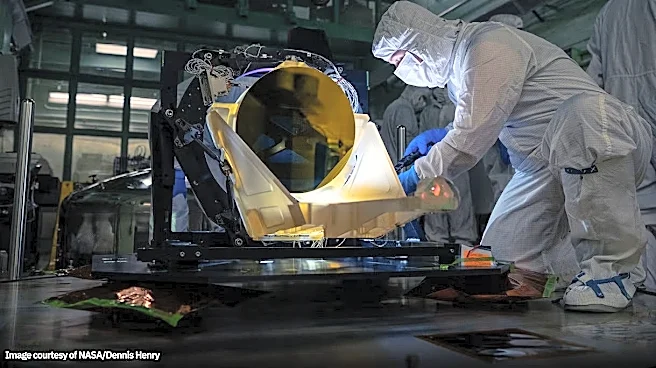
The Psyche spacecraft is a marvel of modern engineering, specifically tailored for its unique mission. Its propulsion system, utilizing solar electric power, is crucial for the long journey to the asteroid belt. The scientific payload is comprehensive, featuring a multispectral imager to capture detailed surface images, a magnetometer to measure magnetic fields, and a gamma-ray spectrometer to analyze the asteroid's elemental composition. These instruments will work in concert to gather data over a planned 21 months of science operations, providing a holistic view of 16 Psyche.
The spacecraft's design and construction involved significant collaboration. Lindy Elkins-Tanton, a principal investigator at Arizona State University, initially submitted the proposal for the Psyche mission as part of NASA's Discovery Program. After being shortlisted and awarded funds for concept development, Psyche was selected as the 14th Discovery mission. The project has seen several adjustments to its timeline, including a launch delay in 2022, which necessitated updates to the mission plan to ensure optimal conditions for studying the asteroid upon arrival.
Navigating the Cosmos: Trajectory and Orbital Operations
Psyche's journey to 16 Psyche is meticulously planned, involving a gravity-assist flyby of Mars and a complex series of orbital maneuvers around the asteroid itself. The spacecraft successfully launched on October 13, 2023, aboard a SpaceX Falcon Heavy rocket. This launch marked the eighth flight for the Falcon Heavy and the first for NASA, with the side boosters being reused for future missions. After separation from the upper stage, the spacecraft began a 100-day commissioning phase to test and calibrate all its systems and instruments.
In May 2026, Psyche is scheduled to perform a crucial gravity-assist maneuver at Mars. This flyby will adjust the spacecraft's orbital tilt around the Sun, aligning its path with the orbital plane of asteroid 16 Psyche. During this maneuver, the spacecraft's instruments will be powered up for calibration, capturing images of Mars from a high phase angle. The approach sequence to 16 Psyche will commence in May 2029, with the first navigation images and measurements taken as the asteroid appears as a few pixels. The spacecraft will then use its electric propulsion system to be captured by the asteroid's gravity, with close-up images expected in late July 2029.
Unveiling the Asteroid: Science Orbits and Data Collection
Once in orbit around 16 Psyche, the spacecraft will execute a sophisticated series of four distinct orbital regimes, each designed to gather specific types of data. The original mission plan involved a sequential descent from highest to lowest altitude. However, due to the 2022 launch delay and the new 2029 arrival date, the orbital sequence was updated to ensure proper solar illumination of the asteroid's surface during key observation periods.
The revised plan dictates that Psyche will initially enter Orbit A, the highest at 700 km, for 56 days to characterize the magnetic field and perform preliminary mapping. It will then descend to Orbit B1 at 303 km for 92 days, focusing on topography and further magnetic field characterization. Next, it will move to Orbit D, the lowest at 75 km, for 100 days, uniquely inclined to view the asteroid's equator and determine surface chemical composition using gamma-ray and neutron spectrometers. Following this, it will ascend to Orbit C at 190 km for 100 days for gravity investigations and continued magnetic field observations. Finally, the spacecraft will return to Orbit B2 for another 100 days to complete mapping of areas previously in darkness and acquire additional imaging, gravity, and magnetic field data. The prime mission is expected to last 26 months, concluding in November 2031, after which the spacecraft will remain in orbit around the asteroid.