
The year 1895 marked a pivotal moment in American transportation history with the staging of the Chicago Times-Herald race. This event, sponsored by the Chicago Times-Herald newspaper, holds the distinction
of being the first automobile race ever held in the United States. More than just a competition, the race served as a powerful catalyst, generating widespread public interest in the nascent automobile industry. At a time when "horseless carriages" were a novel concept, the extensive press coverage surrounding this challenging event introduced many Americans to the potential of motor vehicles, laying groundwork for their eventual integration into daily life.
Genesis of a Groundbreaking Event
The idea for the Chicago Times-Herald race originated with Hermann H. Kohlsaat, the proprietor of the *Times-Herald*. His motivation was twofold: to foster the growth of the young auto industry in the United States and to boost sales of his newspaper. The first automobiles in the nation had only been produced two years prior, making them a truly cutting-edge technology. Kohlsaat put up a substantial prize fund totaling $5,000, which would be approximately $193,500 in 2025, to attract competitors. The organizers even held a competition to find a more forward-looking name than "horseless carriages" or "motor wagons," settling on "Motocycle," though this term ultimately did not gain widespread popularity.
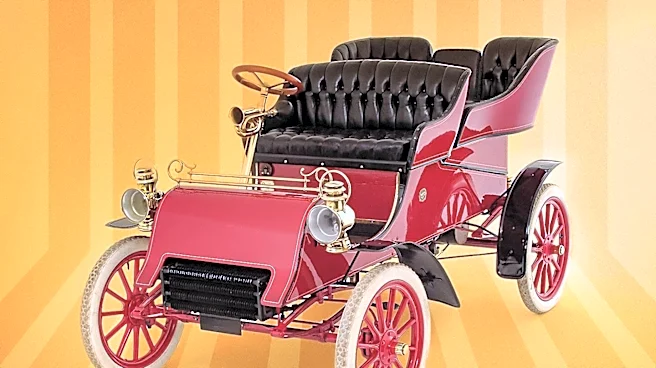
Initial plans for the race involved a course from Chicago north to Milwaukee, but these roads were deemed too poor for the early automobiles. The route was subsequently changed to a 100-mile round trip to Waukegan and back, with the race initially scheduled for November 2, 1895. However, many entrants were not ready, leading to a postponement. An exhibition run was held on November 2, where only two cars participated: a Benz Vis-à-vis driven by Oscar B. Mueller and a Duryea Motor Wagon driven by J. Frank Duryea. The Duryea suffered mechanical issues and a crash, while Mueller's Benz completed the course, albeit with challenges like overheating, requiring ice to keep its engine cool. This exhibition highlighted the nascent stage of automotive technology and the difficulties of early motoring.
The Main Event: A Snowy Thanksgiving Day
The rescheduled race took place on Thanksgiving Day, November 28, 1895, under extremely challenging conditions. Six inches of snow covered the racecourse, and a horse-drawn snowplow proved ineffective. Despite 89 initial entries, only six vehicles made it to the starting line due to the adverse weather and the general unreadiness of many early automobiles. The competitors included J. Frank Duryea in his Duryea Motor Wagon, Oscar B. Mueller in a Benz, a Benz sponsored by Macy's, another Benz sponsored by the De La Vergne Refrigeration Company, and two electric cars: a Sturges Electro Motocycle and a Morris & Salom Electrobat.
The racecourse itself was a 54-mile loop along the lakeshore from Chicago to Evanston, then through various Chicago neighborhoods, and back to the starting point, with the finish line near what is now the Chicago Museum of Science and Industry. The journey was arduous; contestants faced snowdrifts, collisions, and repeated stalls. Two participants even became comatose from exposure to the cold. J. Frank Duryea ultimately won the race, completing the course in 10 hours and 23 minutes, averaging a speed of 5 1/4 miles per hour. The Mueller motocycle finished an hour and a half later, with its pneumatic tires wrapped in twine for traction and one of its operators sanding the motor belt. The Macy's Benz, unfortunately, collided with a streetcar, a sleigh, and a hack, failing to finish, as did the De La Vergne Benz.
Lasting Impact and Legacy
The Chicago Times-Herald race achieved its primary goal: it introduced Americans to the motor-wagon and unequivocally demonstrated that the era of the horse and buggy was drawing to a close. The extensive press coverage generated significant public interest, sparking curiosity and enthusiasm for automobiles across the nation. This event was crucial in shifting public perception and encouraging the development and adoption of automotive technology in the United States. For J. Frank Duryea, his victory spurred further innovation; he returned to his shop and, with his brother Charles, built 13 cars by hand in 1896, establishing what became the first gas-powered automobile factory in the United States. The race, therefore, stands as a landmark event, not just as the first American automobile race, but as a foundational moment in the country's automotive history.