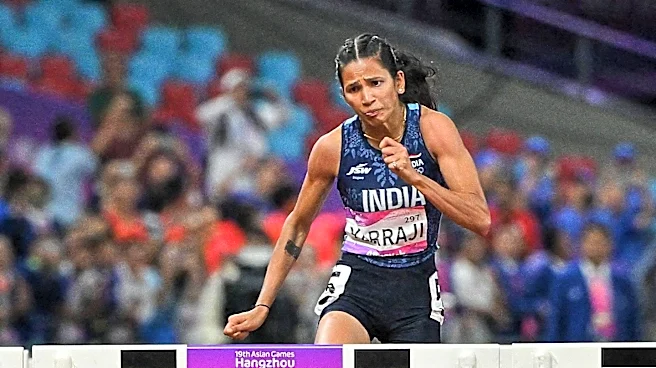




The women's 100 meters hurdles final at the 2016 Summer Olympics, held on August 17 at the Olympic Stadium, delivered a captivating display of speed, precision, and determination. Forty-eight competitors from 34 nations had vied for a spot in this climactic race, but it was the eight finalists who lined up, ready to contend for Olympic glory. The race unfolded with intense drama, showcasing individual efforts that culminated in an unforgettable finish
and a historic outcome. Spectators watched as athletes navigated ten hurdles, each 83.8 centimeters high, over a 100-meter course, where every stride and clearance was critical.
Rollins's Early Dominance and the Initial Battle
From the sound of the starting gun, Brianna Rollins of the United States immediately asserted her presence, establishing a clear lead by the time she cleared the first hurdle. Her powerful start and efficient hurdling technique allowed her to gain an early advantage over the field. As the race progressed to the second barrier, it became evident that her compatriot, Nia Ali, was her closest challenger, maintaining a strong and consistent pace in pursuit. The American duo quickly separated themselves from the rest of the pack, setting up a potential one-two finish.
Further back, the competition for the remaining medal position was fierce. Sisters Cindy Ofili and Tiffany Porter, both American-born but representing Great Britain through their mother's heritage, were running neck and neck, positioned evenly in what appeared to be the battle for third place. Meanwhile, Kristi Castlin, another American contender, found herself in a challenging position, battling for last place with Phylicia George of Canada and Cindy Roleder of Germany. At this early stage, Castlin was approximately half a stride behind Rollins, indicating the ground she would need to make up to contend for a medal.
Castlin's Remarkable Mid-Race Surge
The middle section of the race proved to be the turning point for Kristi Castlin. Between the fourth and sixth hurdles, she initiated a remarkable and powerful surge, demonstrating exceptional acceleration and improved hurdling rhythm. This period saw Castlin "getting rolling," as she steadily began to gain on her competitors. Her determined effort allowed her to first overtake Pedrya Seymour of the Bahamas, who had been ahead of her. Following this, she successfully passed Tiffany Porter, moving further up the field.
Castlin's momentum continued to build, culminating in a decisive move over the last hurdle where she managed to pass Cindy Ofili, who had been holding a strong third-place position. This incredible mid-race recovery and strategic execution propelled Castlin from a trailing position into medal contention. Her ability to maintain composure and accelerate through the most technical part of the race was crucial to her eventual success, transforming her race from a struggle for position into a fight for the podium.
The Dramatic Finish and Medal Allocation
As the athletes entered the final stretch, the outcome of the gold medal was clear: Brianna Rollins maintained her significant lead, securing a decisive victory with a time of 12.48 seconds. She crossed the finish line with a clear one-meter advantage, a testament to her dominant performance. The real drama unfolded behind her, as Nia Ali, who had been Rollins's closest pursuer throughout the race, held on to secure the silver medal with a time of 12.59 seconds.
The battle for bronze was incredibly tight. Kristi Castlin, having made her impressive surge, came very close to Nia Ali in the final run-in, demonstrating her powerful finish. Cindy Ofili, despite being passed over the last hurdle, gave her best desperate lean at the finish line, attempting to reclaim a podium spot. Ultimately, Castlin's strong finish earned her the bronze medal with a time of 12.61 seconds, completing the historic American sweep. The final results saw Rollins, Ali, and Castlin standing atop the podium, their performances etched into Olympic history.