






The John F. Kennedy Presidential Library and Museum stands today as a significant institution, but its journey from concept to dedication was marked by numerous stages and decisions. Conceived as a tribute to President Kennedy, the project involved careful selection of an architect, changes in location, and a dedicated fundraising effort. The eventual dedication ceremony in 1979 marked the culmination of years of planning and construction, bringing
together family, political figures, and the public to honor the late president's legacy. This institution is now a vital part of the Presidential Library System, overseen by the National Archives and Records Administration.
The Architect's Selection and Initial Vision
The process of bringing the John F. Kennedy Presidential Library and Museum to fruition began with the crucial selection of its architect. On December 13, 1964, the Kennedy family announced that I. M. Pei had been unanimously chosen by a subcommittee for the role. At the time, Pei was relatively unknown among the list of candidates, but Jacqueline Kennedy saw great promise and imagination in his work. After several months of inspecting various architects' offices and creations, she personally selected him, driven by a desire to create the vision she held for the project.
Mrs. Kennedy's decision was based on two main considerations. First, she admired the variety of ideas Pei had demonstrated in his earlier projects, noting that he approached each commission with a fresh perspective, aiming to create something beautiful. Second, her choice was deeply personal and emotional. She felt a connection with Pei, describing him as "so full of promise, like Jack; they were born in the same year." She decided it would be an exciting "great leap" to undertake the project with him. At this early stage, Pei did not yet have a specific design, but Robert Kennedy articulated the goal: to "stimulate interest in politics." Even as Pei was selected, discussions began to emerge questioning whether Harvard would be a suitable site for the library.
Shifting Locations and Design Evolution
The initial plans for the library faced significant challenges, leading to a change in location and a revised architectural approach. The suggestion that Harvard might not be the ideal site for the library gained traction, and Pei himself acknowledged that he would likely have to start from scratch with a new location. Robert Kennedy offered him an "encouraging grin" and simply wished him "Good luck" as the project evolved. Meanwhile, fundraising efforts were robust; the initial goal of $10 million had been reached shortly before Pei's selection, and by 1965, contributions had reached $20 million, leading to a suspension of further fundraising.
By 1975, a new direction was announced. The John F. Kennedy Presidential Library Corporation decided to locate the library on a 10-acre site provided by the University of Massachusetts Boston. This site was adjacent to its campus on the Columbia Point peninsula. The new location presented a stark contrast to the original Harvard Square idea, being described as a collection of "massive, blocky structures" rather than fitting into a "mellow and urbane atmosphere." The chosen site had previously been a garbage dump, with Pei recalling finding old appliances and even methane gas that could ignite if a lit match were tossed on the ground. Despite these initial conditions, the official groundbreaking took place on June 12, 1977, with construction commencing in August. The site offered views of Boston, Dorchester Bay, and the ocean, and was covered with 15 feet of earth and topsoil, a landscaping effort Pei was particularly proud of.
Architectural Design and Dedication
The final design for the John F. Kennedy Presidential Library and Museum was a simple geometric structure featuring a large glass pavilion. A 125-foot-tall concrete tower houses offices and archives, while a circular section contains two theaters. These elements are connected by a 115-foot grey-glass pavilion. The choice of concrete for the building's finish was a direct reflection of the budget; Pei noted that with more funds, he would have preferred stone for a finer finish and greater detail. Nevertheless, the selected materials kept the project within its $20.8 million budget, with over 30 million people contributing to the construction costs. More than 225 construction workers labored to complete the building before the end of 1979.
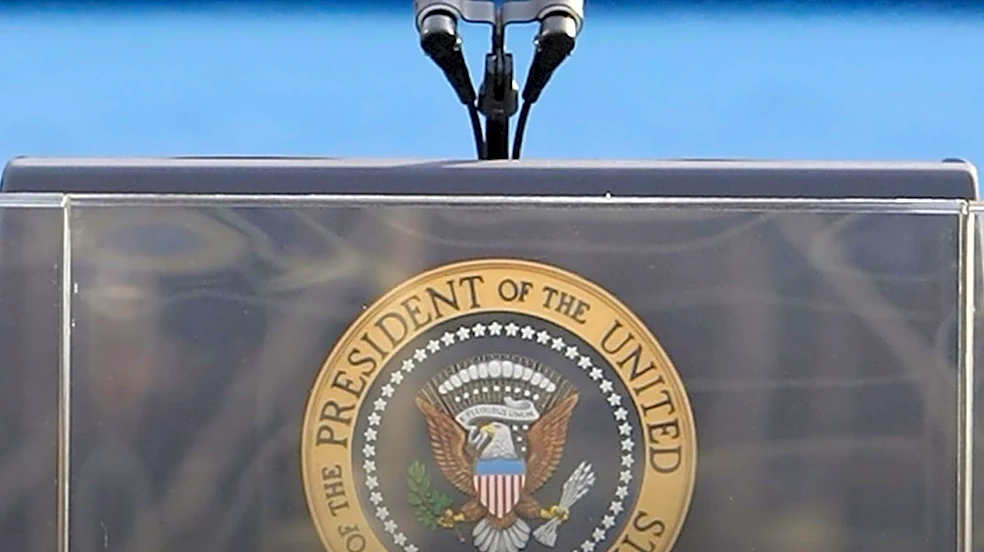
The dedication ceremony for the library and museum was held on October 20, 1979. The event took place outdoors on the green, where a blue-carpeted stage adorned with yellow chrysanthemums hosted the Kennedy family and their close associates, alongside President Jimmy Carter and many other dignitaries. The ceremony began with Caroline Kennedy introducing her brother, John F. Kennedy Jr., who read from Stephen Spender's poem, "I Think Continually of Those Who Were Truly Great." President Carter spoke of John F. Kennedy embodying "the ideals of a generation," recalling his own emotional reaction to Kennedy's death. He formally accepted the library "on behalf of the American people" and the National Archives and Records Administration. Senator Edward M. Kennedy reflected on his brother's life as "a voyage of discovery, a quest for excellence that inspired universal trust and faith," asserting that Kennedy "filled America with pride and made the nation young again." While critics generally appreciated the finished building, Pei himself expressed some dissatisfaction, feeling that years of conflict and compromise had diminished the original passion of his design. Despite this, he considered the John F. Kennedy Library "the most important commission in my life," and the project significantly elevated his public profile as an architect.