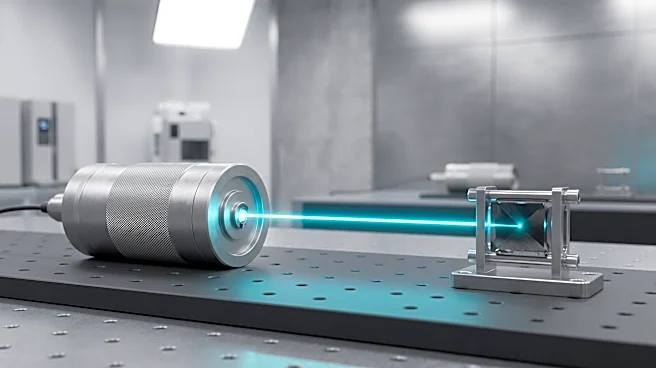






Gordon Gould, an American physicist born in New York City in 1920, is often recognized for his significant contributions to the development of the laser and the optical amplifier. While the credit for the laser's invention is sometimes disputed among several scientists, Gould is notably credited with coining the acronym "LASER" itself. Beyond his scientific insights, Gould became widely known for an arduous, thirty-year legal battle against the United
States Patent and Trademark Office to secure patents for his laser-related technologies. This prolonged fight also extended to court battles with laser manufacturers, as he sought to enforce the patents he eventually obtained.
Early Life and Academic Pursuits
Born the oldest of three sons, Gould's parents, Helen Vaughn (née Rue) and Kenneth Gould, were active Methodists in their local church. Despite his parents' religious involvement, Gould identified as an atheist. His father was the founding editor of Scholastic Magazine Publications in New York City, and his mother fostered his early interest in inventors like Thomas Edison, providing him with an Erector set. Gould grew up in Scarsdale, a suburb of New York, and attended Scarsdale High School.His academic journey led him to Union College, where he earned a Bachelor of Science in physics. He then pursued and obtained a master's degree at Yale University, specializing in optics and spectroscopy. From March 1944 to January 1945, Gould worked on the Manhattan Project, but his involvement was cut short due to his activities as a member of the Communist Political Association. In 1949, he moved to Columbia University to work on a doctorate in microwave optics and spectroscopy. His doctoral advisor, Polykarp Kusch, a Nobel laureate, sparked Gould's interest in a new technique called optical pumping.
The Genesis of the Laser Concept and Naming
In 1956, Gould proposed using optical pumping to excite a maser and discussed this idea with Charles Townes, another Nobel laureate and a professor at Columbia University at the time. Townes advised Gould on how to secure a patent for his invention. By November 1957, Gould realized that an optical resonator, constructed from two mirrors resembling a Fabry-Pérot interferometer, could be used to amplify light, similar to how a MASER amplified microwaves. This innovative concept allowed for the creation of a narrow, coherent, and intense beam of light. He also considered pumping through atomic collisions and foresaw numerous potential applications for his device.It was during this period that Gould documented his ideas and proposed designs in a laboratory notebook. The title of this notebook entry, "Some rough calculations on the feasibility of a LASER: Light Amplification by Stimulated Emission of Radiation," marked the first recorded use of the acronym LASER. This description was the first to detail how a practical laser could be built. Recognizing the significance of his creation, Gould had his notes notarized, a crucial step that would later play a role in his patent disputes. While Arthur Schawlow and Charles Townes independently discovered the importance of the Fabry-Pérot etalon and, about three months later, named their device an "optical maser," Gould's term "LASER" first appeared publicly at a conference presentation in 1959 and gained acceptance despite initial resistance from Schawlow and his colleagues.
The Thirty-Year Patent War
Gould's most defining struggle was his three-decade-long fight to secure and enforce patents for his laser inventions. This extensive legal battle became one of the most significant patent disputes in history. Initially, he faced numerous setbacks in court regarding the laser itself. However, in 1977, a shift in strategy led to a breakthrough when he was awarded U.S. patent 4,053,845, covering optically pumped laser amplifiers, a critical component of any laser. The laser industry, by then a $400 million annual market, resisted paying royalties, leading to further court battles. Despite industry opposition and the patent office's stalling on other applications, Gould secured U.S. patent 4,161,436 in 1979, which covered a wide array of laser applications, including heating, welding, cutting, measuring distance, communication, and even laser fusion.To manage the patent rights and handle licensing, Gould and his financial backers founded Patlex in 1979. The legal challenges persisted, with the industry attempting to revoke his existing patents and prevent new ones. A turning point came in 1985 when a Federal Court ordered the Patent Office to issue Gould's patent on collisionally pumped laser amplifiers. The Patent Office's appeal failed, leading to the issuance of U.S. patent 4,704,583 and the abandonment of attempts to rescind his earlier patents. In 1987, Patlex achieved its first major enforcement victory against Control Laser Corporation, which ultimately led to other manufacturers settling and licensing the technology. By the end of this protracted legal saga, Gould had been issued forty-eight patents, with the optical pumping, collisional pumping, and applications patents being the most crucial, covering most lasers in use at the time. Although he had signed away eighty percent of his proceeds to cover legal costs, Gould still earned several million dollars from his inventions. His election to the National Inventors Hall of Fame in 1991, despite ongoing disputes over his role in the laser's invention, underscored the eventual recognition of his contributions.