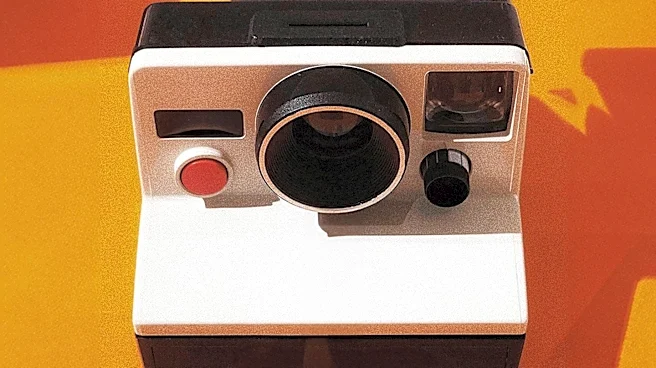

The story of the original Polaroid Corporation is not just one of innovation and success, but also a cautionary tale of a company struggling to adapt to rapid technological shifts. Founded in 1937 by Edwin
H. Land, Polaroid was a pioneer in instant photography, but its inability to consistently innovate and capture new markets ultimately led to its federal Chapter 11 bankruptcy protection filing on October 11, 2001. This decline was marked by several key product failures and a broader struggle to transition from its analog roots into the burgeoning digital age.
The Polavision Debacle and Leadership Change
One of the earliest and most significant missteps in Polaroid's technological journey was the introduction of the Polavision instant home movie camera in 1977. This product, based on the Dufaycolor process, arrived on the market at an unfortunate time. Videotape-based systems were rapidly gaining popularity, offering consumers a more versatile and future-proof solution for home video recording. As a result, Polavision failed to sell well in retail stores and was widely described as the "swan song" for Polaroid's founder, Edwin Land. The product's failure was so impactful that Land was coerced into resigning and leaving the corporation he had founded after four decades as chairman. The Polavision debacle eventually forced the company to write off $89 million, including most of the manufactured products, highlighting the financial consequences of misjudging market trends and technological advancements.
Despite this setback, the underlying technology of Polavision was later improved and utilized in the Polachrome instant slide film system, indicating that the core innovation had some merit, even if its initial application was ill-timed. William J. McCune Jr., who joined the company in 1939, was appointed CEO in 1980, leading the company until late 1985, with I. M. Booth taking over as chief executive, while McCune remained chairman.
Navigating the 1980s and the Rise of Digital
In the 1980s, without Edwin Land at the helm, Polaroid attempted to reinvent itself by shifting away from its heavy dependence on consumer photography, a market that was already showing signs of steady decline. The company explored new avenues, such as announcing in 1984 its entry into the United States electronic video market with its own line of Polaroid videotapes. However, these efforts were not enough to stem the tide of change. The decade saw the advent of new technologies that profoundly altered the world of photography, including one-hour color film processing, single-use cameras from competitors, and videotape camcorders.
The challenges intensified in the 1990s and 2000s with the rapid rise of digital cameras. While Polaroid was, in fact, one of the early manufacturers of digital cameras, releasing the PDC-2000 in 1996, it failed to capture a large market share in this emerging segment. The company also ventured into making 35 mm and multi-format scanners, such as the Polaroid SprintScan 4000 35 mm scanner in 1999 and the Polaroid PrintScan 120 in 2000. These scanners received mixed reviews and faced heavy competition from established players like Nikon and Minolta. Ultimately, the entire line of scanners was discontinued when Polaroid entered bankruptcy in 2001, underscoring its inability to successfully diversify and compete in new technological arenas. The company was forced to make wholesale changes, including firing thousands of workers and closing many factories, as it grappled with these market shifts.