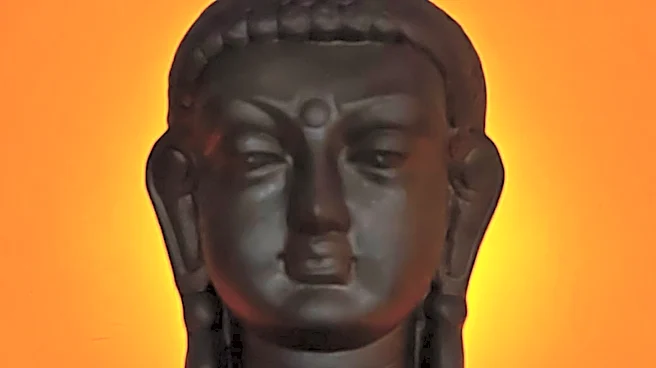







The Dhyana mudra, often referred to as the "meditation mudra," is a profound symbolic gesture deeply embedded in Buddhist iconography. This hand position signifies meditation, the concentration of the Good Law, and the sangha, or monastic community. It is a visual shorthand for the state of deep contemplation and spiritual focus, frequently depicted in representations of important Buddhist figures. Understanding the specific arrangement of the hands
and fingers, as well as its historical and regional variations, offers insight into the rich visual language of Buddhist art and practice.
Form and Symbolism of the Dhyana Mudra
The Dhyana mudra is characterized by a specific arrangement of the hands. Both hands are placed on the lap, with the right hand resting on the left. The fingers are fully extended, and the four fingers of each hand rest upon each other. The thumbs are positioned to face diagonally upward towards each other, and the palms are turned upwards. This precise configuration of the hands and fingers creates the shape of a triangle. This triangular form is highly symbolic, representing spiritual fire or the Three Jewels of Buddhism: the Buddha, the Dharma (teachings), and the Sangha (community).
This gesture is not merely an aesthetic choice but a deliberate representation of the meditative state. It embodies the stillness, focus, and inner peace associated with deep meditation. The placement of the hands in the lap suggests a grounding and centered posture, conducive to spiritual concentration. The upward-facing palms indicate receptivity, while the joined hands symbolize unity and the integration of different aspects of being during meditation.
Prominent Figures and Regional Variations
The Dhyana mudra is commonly seen in depictions of two significant Buddhist figures: Gautama Buddha and Amitābha. For Gautama Buddha, this mudra often represents the moment of his enlightenment under the Bodhi tree, a period of intense meditation and realization. In the case of Amitābha, a celestial Buddha revered in Mahayana Buddhism, the Dhyana mudra emphasizes his role as a Buddha of infinite light and boundless compassion, often associated with pure lands and meditative practices.
Beyond these primary figures, the Dhyana mudra also appears in representations of Bhaiṣajyaguru, known as the "Medicine Buddha." In these instances, a medicine bowl is typically placed upon the hands, adding another layer of symbolism related to healing and well-being. The mudra's origins can be traced back to India, likely emerging in Gandhāra, and subsequently spreading to China during the Northern Wei dynasty. Its use became widespread in Southeast Asia, particularly in Theravada Buddhism, though with a slight variation where the thumbs are placed against the palms.
Naming and Japanese Adaptations
The Dhyana mudra is known by several names, reflecting its significance across different traditions. It is also referred to as "samādhi mudrā" or "yoga mudrā." In Hanyu Pinyin, it is known as [Chán]dìng yìn, and in Japanese pronunciation, it is called jōin or jōkai jōin. These alternative names underscore its connection to meditative states and yogic practices.
Japan developed a unique variation of the Dhyana mudra known as the *mida no jōin*. In this specific Japanese form, the index fingers are brought together with the thumbs, creating a slightly different hand shape. This variation was predominantly used in Japan with a particular purpose: to distinguish Amitābha (referred to as "mida" in this context) from the Vairocana Buddha. This subtle modification in the mudra's execution highlights how cultural and theological nuances can lead to distinct artistic interpretations, even for a widely recognized gesture. The *mida no jōin* was rarely seen outside of Japan, emphasizing its localized significance within Japanese Buddhist art.