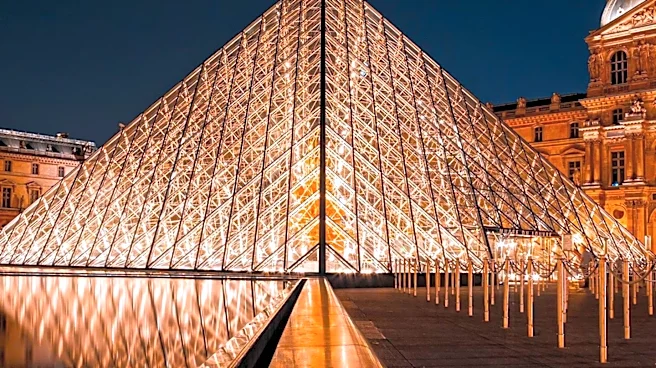







The Louvre Museum, renowned globally for its vast art collection, has a fascinating history rooted in the private acquisitions of French monarchs. What began as a means to decorate royal residences and assert cultural prestige gradually transformed into a public institution, making art accessible to all. This journey involved strategic purchases, diplomatic gifts, and significant shifts in the philosophy of art ownership and display, culminating in the establishment
of one of the world's most visited art museums.
Early Royal Acquisitions and the Birth of a Collection
Francis I is recognized as the first French king to systematically build a "cabinet of paintings," a collection of easel paintings not solely tied to royal decor but intended for independent display. A pivotal moment was his acquisition of Leonardo da Vinci's works in 1518, including the Mona Lisa, from the artist's pupil Salai. Louis XII had earlier acquired Italian paintings, including a Madonna from Leonardo da Vinci in 1507, though it has since disappeared. These early acquisitions laid the groundwork for what would become the royal collection.
During the reign of Louis XIII, there wasn't a particular interest in painting or sculpture, though Nicolas Poussin was brought from Rome in 1641 to decorate the new wing of the Louvre. However, it was under Louis XIV, starting in 1661, that the enrichment of the crown's collection became a focused endeavor. Louis XIV acquired a significant portion of Cardinal Mazarin's art collection after his death in 1661, which included 546 original paintings and 130 sculptures. He also purchased works from the collection of the Duke of Richelieu, including paintings by Nicolas Poussin and Claude Lorrain. Diplomatic gifts, such as Veronese's "The Wedding Feast at Cana" from the Republic of Venice, further enriched the collection, alongside offerings from courtiers seeking royal favor.
Shifting Tastes and the Move Towards Public Display
By the early 18th century, artistic tastes began to shift. The grand paintings favored by Charles Le Brun no longer suited the smaller, more intimate apartments of the rising bourgeoisie. There was a growing appreciation for smaller works, particularly from Dutch and Flemish masters, and a market for art began to flourish in Paris and Amsterdam. Despite this, Louis XV made few additions to the royal collections. However, the idea of making art accessible to the public started to emerge. In 1746, Étienne La Font de Saint-Yenne criticized the difficulty of viewing the king's collection, advocating for a public museum.
This advocacy led to a temporary exhibition of royal paintings at the Luxembourg Palace from 1750 to 1779, which proved highly successful. This exhibition, open to the public on specific days, marked a significant step towards the democratization of art. In 1765, the Encyclopédie, edited by Denis Diderot and D'Alembert, even outlined a program for a future museum at the Louvre, envisioning it as a place to display statues and paintings currently scattered or stored away. Under Louis XVI, the Count d'Angiviller, appointed director of the Bâtiments du Roi in 1774, actively pursued a policy of acquiring paintings from various schools to fill gaps in the royal collection and make it as comprehensive as possible for public instruction.
The Revolutionary Era and the Birth of the Museum
The French Revolution marked a turning point for the royal collections. Following the abolition of the monarchy, the Louvre Palace was designated for artistic and scientific functions. On November 8, 1793, part of the Louvre opened to the public as a museum. This was a revolutionary concept, nationalizing royal property and offering free access to all, not just the educated elite. The revolution also led to the acquisition of art through the suppression of monastic orders, the disaffection of churches, and the abandonment of goods by fleeing nobility.
During the Napoleonic era, the museum, renamed the Musée Napoléon in 1803, saw a significant increase in its collections as Napoleon's armies requisitioned artworks from invaded countries. While some of these works were returned after the fall of the Napoleonic regime, many important pieces, such as "The Wedding Feast at Cana" by Veronese, remained in the Louvre. This period solidified the Louvre's status as a repository of world art. Today, the Louvre houses approximately 500,000 objects, with 35,000 works displayed across eight curatorial departments, covering art from prehistory to the 21st century, making it the largest museum in the world by exhibition area.