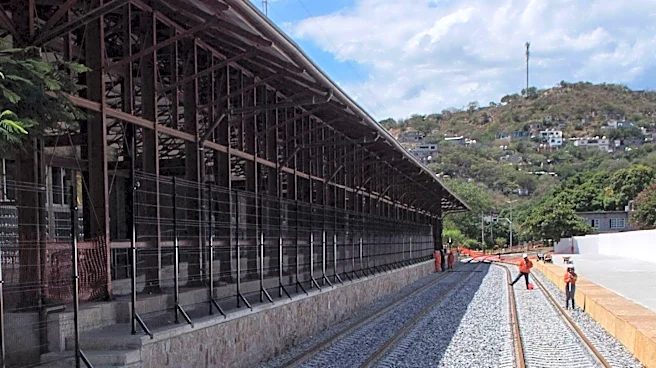




The construction of the Panama Canal Railway in the mid-19th century stands as a stark reminder of the immense human cost and engineering challenges involved in taming nature for progress. Before the canal itself, this railway project pushed the limits of endurance and innovation, carving a path through one of the world's most unforgiving environments. The story of its creation is one of relentless struggle against disease, treacherous terrain, and the sheer
force of the tropical wilderness.
Initial efforts to survey a route for the proposed Panama Railroad were plagued by errors and overly optimistic forecasts, rendering them largely useless. When the Panama Railroad company, led by William Henry Aspinwall, decided to establish its Atlantic terminus, it chose the vacant Manzanillo Island, now Colón. This decision immediately plunged the project into a battle against nature. The island was a treacherously marshy islet, densely covered with mangrove trees and poisonous manchineel. Early buildings had to be constructed on stilts to keep them above the water, and abandoned ships were even towed in to serve as temporary housing for the burgeoning workforce.
A Battle Against Nature and Disease
The true scale of the environmental challenge became apparent as construction moved onto the mainland. The initial eight miles of the proposed route passed through a jungle characterized by gelatinous swamps, where alligators lurked. The heat was stifling, and workers were constantly assailed by mosquitoes and sandflies. For almost half the year, deluges of rain, sometimes up to three yards, meant that laborers often worked in swamp water up to four feet deep. The swamps were so deep that over 200 feet of gravel backfill was frequently required to secure a stable roadbed, with sandstone quarried near Porto Bello and transported by barge.
Technological limitations meant that most of the work was manual. Beyond a steam-driven pile driver, steam tugs, and steam locomotives used for carrying fill material, the vast majority of the labor was performed by hand, using machetes, axes, picks, shovels, black powder, and mule carts. The roadbed, once laid, continued to slowly sink into the swamp, necessitating continuous backfilling. The first stretch of solid ground, at what was then known as Monkey Hill (now Mount Hope), quickly transformed into a cemetery, a grim testament to the project's human toll.
The Devastating Human Cost
Disease proved to be the most formidable adversary. Cholera, yellow fever, and malaria swept through the workforce, taking a deadly toll. The year 1852 was particularly devastating, with a cholera outbreak following the arrival of a boat from New Orleans. This epidemic claimed nearly all of Chief Engineer George Totten's staff, including 51 engineers, surveyors, and draftsmen. John Lloyd Stephens, one of the founding owners who spent time in Panama, succumbed to malaria. Even Army Captain Ulysses S. Grant's 4th Infantry regiment, crossing the isthmus for garrison duty in California, was struck by cholera, resulting in over 150 deaths among his party. Grant himself would later recount the horrors he witnessed in Panama more vividly than any of his battle experiences.
The constant importation of new workers was necessary to replace those lost to disease, yet there were times when progress stalled due to a simple lack of available labor. Laborers came from diverse backgrounds, including the United States, the Caribbean Islands, Ireland, India, China, and Australia, all facing the same perilous conditions. All supplies and nearly all foodstuffs had to be imported from thousands of miles away, significantly escalating the cost of construction. The project ultimately claimed the lives of an estimated 5,000 to 10,000 workers.
Even after the initial track was laid, challenges persisted. By July 1852, the railway reached the Chagres River, where an enormous bridge was required. The first wooden bridge was washed away when the Chagres rose by over 40 feet in a single day, necessitating the construction of a much higher, 300-foot-long iron bridge that took more than a year to complete. In total, over 170 bridges and culverts were built. In January 1854, excavation began at the Culebra Cut, where the Continental Divide required a cut 20 to 40 feet deep over a distance of about 2,500 feet. The arrival of 700 Chinese laborers in March 1854 further underscored the immense demand for manpower in this monumental and deadly undertaking. On January 27, 1855, Chief Engineer George M. Totten drove the final spike, completing the railway, but the victory was hard-won and etched in the sacrifice of thousands.