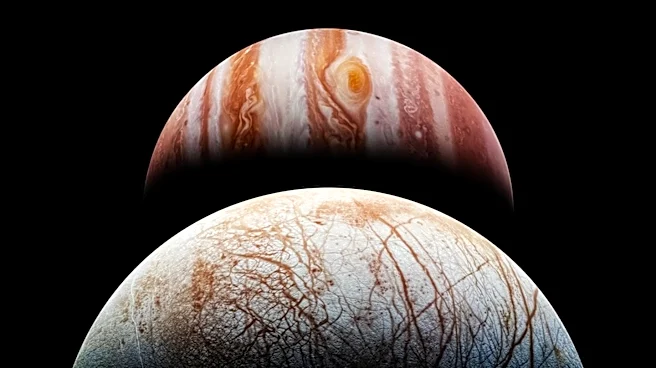







Jupiter, the largest planet in our solar system, is not only known for its massive size and iconic Great Red Spot but also for its intricate ring system. Among the many moons orbiting Jupiter, Adrastea plays a crucial role in maintaining and replenishing these rings. Discovered in 1979 by the Voyager 2 spacecraft, Adrastea is the smallest and second closest moon to Jupiter, and its proximity to the planet's main ring makes it a significant contributor
to the ring's material.
Adrastea's Orbit and Physical Characteristics
Adrastea orbits Jupiter at a distance of approximately 129,000 kilometers, placing it at the edge of the planet's main ring. Its orbit is characterized by a very small eccentricity and an inclination relative to Jupiter's equator, which suggests a stable and consistent path around the planet. The moon is tidally locked to Jupiter, meaning it rotates synchronously with its orbital period, always showing the same face to the planet.
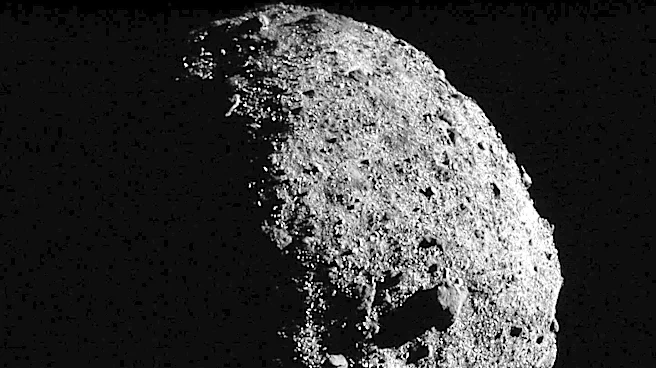
Physically, Adrastea is irregularly shaped, measuring about 20 km by 16 km by 14 km. Despite its small size, the moon's contribution to Jupiter's ring system is significant. The bulk composition and mass of Adrastea are not well known, but it is assumed to be similar to that of Amalthea, another of Jupiter's moons, which is composed primarily of water ice. This composition, combined with its proximity to Jupiter, makes Adrastea a key player in the dynamics of the planet's rings.
Contribution to Jupiter's Rings
Adrastea is considered the largest contributor of material to Jupiter's rings. The material in the rings is thought to consist primarily of debris ejected from the surfaces of Jupiter's small inner satellites, including Adrastea, due to meteorite impacts. These impacts are frequent due to the moons' low density and their surfaces lying close to the edge of their Hill spheres, making it easy for impact ejecta to escape into space.
The densest part of Jupiter's main ring is located at and within Adrastea's orbit, indicating the moon's significant role in supplying material. The exact extent of visible ring material varies depending on the phase angle of the images, but Adrastea's contribution remains evident. This relationship between the moon and the rings provides valuable insights into the processes governing ring formation and maintenance.
The Future of Adrastea and Jupiter's Rings
Adrastea's orbit lies inside Jupiter's synchronous orbit radius, meaning tidal forces are slowly causing its orbit to decay. Eventually, this decay could lead to the moon impacting Jupiter. However, for now, Adrastea continues to play a vital role in the dynamics of Jupiter's ring system.
The study of Adrastea and its interactions with Jupiter's rings has been instrumental in understanding the complex processes that govern ring systems around giant planets. As future missions continue to explore Jupiter and its moons, Adrastea's contribution to the planet's rings will remain a key area of interest for scientists seeking to unravel the mysteries of our solar system.