








Rhetoric, the art of persuasion, stands as one of the three ancient arts of discourse, alongside grammar and logic/dialectic, that formed the trivium of classical antiquity. As an academic discipline within the humanities, rhetoric focuses on studying the techniques speakers and writers employ to inform, persuade, and motivate their audiences. It also offers methods for understanding, discovering, and developing arguments for specific situations.
Its origins trace back to Ancient Greece around 600 BCE, where it began as a civic art, training students in oratorical persuasion, particularly for legal disputes.
The Sophists and Early Greek Oratory
The school of pre-Socratic philosophers known as the Sophists played a crucial role in the genesis of rhetoric in Ancient Greece. Figures like Demosthenes and Lysias emerged as significant orators during this period, while Isocrates and Gorgias were prominent teachers. Modern discussions of classical rhetoric and persuasion continue to reference these early rhetoricians and their contributions. The Sophists, a group of intellectuals from Sicily, taught the ancient Greeks the art of persuasive speech, which was essential for navigating the courts and the senate in the newly formed democracy.
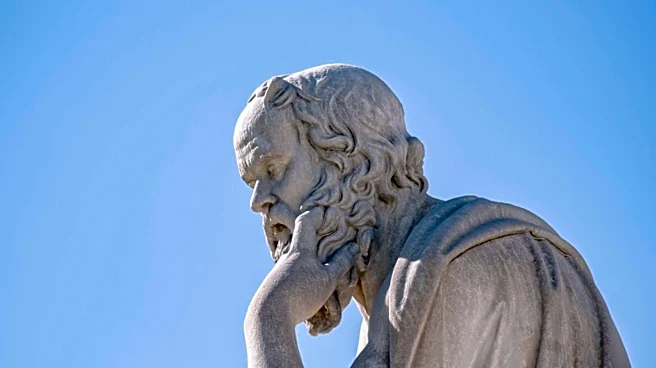
However, the rise of persuasive speech also sparked concerns that it could overpower truth. Plato, for instance, criticized sophistic rhetoric in his dialogue *Gorgias*, viewing it as immoral, dangerous, and unworthy of serious study, especially after his teacher Socrates was sentenced to death following Sophists' efforts. Plato's later dialogue, *Phaedrus*, offered a more nuanced perspective, acknowledging rhetoric's potential value when wielded by a true philosopher for "winning the soul through discourse."
Aristotle's Systematic Approach to Rhetoric
Aristotle, a student of Plato, significantly advanced the study of rhetoric, developing a systematic approach that has influenced rhetorical theory from ancient times to the present. He defined rhetoric as "the faculty of observing in any given case the available means of persuasion." Aristotle considered rhetoric a counterpart to dialectic, both concerned with probability and practical debate, making them well-suited for human affairs. While logic aims for scientific certainty, dialectic and rhetoric deal with probable knowledge.
Aristotle identified three primary persuasive audience appeals: *logos* (reasoning), *pathos* (emotional appeals), and *ethos* (the speaker's character and credibility). He also categorized rhetoric into three divisions of oratory for public settings: political (deciding about future events), forensic (deciding about past events, as in legal cases), and ceremonial oratory of display (observing the orator's skill). Eugene Garver, in his critique of Aristotle's *Rhetoric*, confirms Aristotle's view of rhetoric as a civic art, combining technical skill with appropriateness for citizens.
The Roman Contribution: Canons of Rhetoric
Building upon Greek foundations, classical Rome further systematized rhetoric. The five canons of rhetoric, which outline the phases of developing a persuasive speech, were first codified in this era. These canons include *invention* (discovering arguments), *arrangement* (organizing arguments), *style* (choosing appropriate language), *memory* (memorizing the speech), and *delivery* (presenting the speech effectively). The Roman orator Cicero, influenced by Aristotelian ideas, emphasized that effective rhetoric required more than just eloquence.
Cicero argued that a good orator also needed to be a good person, knowledgeable in various civic topics. In *De Oratore*, he stressed that effective rhetoric stems from a combination of wisdom (*sapientia*) and eloquence (*eloquentia*). For Cicero, the ideal orator demonstrated not only stylistic skill but also moral integrity and broad learning, thereby uniting theory and practice for the betterment of the state. This Roman tradition underscored rhetoric's role as both an intellectual and ethical pursuit, further solidifying its importance in civic life and education.