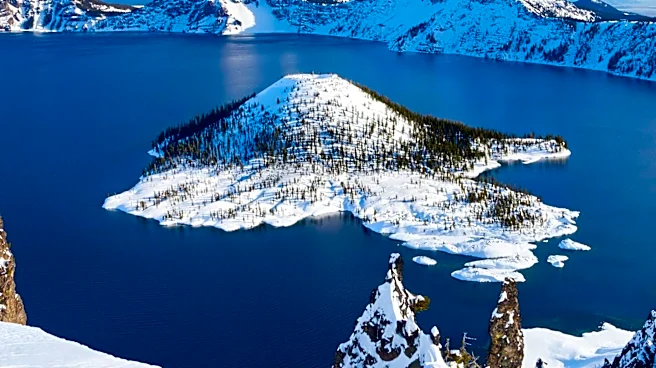






Crater Lake National Park, situated in southern Oregon, experiences a distinctive climate characterized by significant snowfall and notable seasonal variations. Classified under the Köppen climate system as a dry-summer subarctic climate (Dsc), the park's high elevation and the strong summer influence of the North Pacific High contribute to its unique weather patterns. While summers are typically mild and dry, winters are cold and marked by enormous
snowfalls, largely due to the powerful influence of the Aleutian Low. This dynamic climate shapes both the landscape and the visitor experience throughout the year.
A Winter Wonderland: Record Snowfalls and Lingering Snowpack
Snow is a defining feature of Crater Lake National Park, particularly at higher elevations. Measurements taken at park headquarters, located 6,475 feet (1,974 m) above sea level, indicate that this area receives more snow than any other long-term weather station in Oregon. Winter, which generally spans from September through June, averages 101 days with measurable snowfall. The park has seen impressive single-day snowfalls, with up to 37 inches (94 cm) recorded in 1937, 1951, and 1971. Monthly totals can be even more staggering, with January 1950 experiencing 313 inches (800 cm) of snow, and the year 1950 setting a record with 903 inches (2,290 cm).
By early spring, snow typically accumulates to depths of 10 to 15 feet (3.0 to 4.6 m) across the park. This heavy snowpack means that most of the park's roads remain closed well into late spring, and snow can linger into the summer months. The average annual snowfall is a remarkable 463.1 inches (1,178 cm). The less complete snow cover records show depths as high as 192 inches (4.88 m) during a particularly unsettled winter in 1981/1982. The heaviest daily snowfall on record was 37.0 inches (94.0 cm) on February 28, 1971, and it's not uncommon for 20 inches (51 cm) or more to fall in a single storm, even in June and September.
Temperature Extremes and Lake Stability
The park experiences a wide range of temperatures throughout the year. December is the coldest month, with average highs around 33°F (1°C) and lows around 19°F (-7°C). August, in contrast, is the warmest, with average highs of approximately 69°F (21°C) and lows around 42°F (6°C). The highest recorded temperature in the park was 100°F (38°C), while the lowest plunged to -21°F (-29°C). Hard frost is possible even into the summer, with the average window for freezing temperatures extending from August 20 through July 10.
Despite the extensive snowfall and cold winter temperatures, Crater Lake itself rarely freezes over completely. This resistance to freezing is partly due to a relatively mild onshore flow from the Pacific Ocean, but primarily because the lake's immense depth acts as a heat reservoir. This reservoir absorbs and traps sunlight during warmer months, maintaining the lake's temperature. The last recorded year the lake completely froze over was in 1949, during an exceptionally long and cold winter. A 95% surface freeze occurred in 1985, and skim ice occasionally forms small patches. However, with the warming climate of southern Oregon, a complete freezing of the lake is becoming increasingly less likely.