







For centuries, geometry was almost exclusively defined by the principles laid out in Euclidean geometry, a system that provided a robust framework for understanding the physical world through concepts like points, lines, planes, and distances. However, the 19th century emerged as a transformative era for this ancient branch of mathematics. A series of groundbreaking discoveries during this period dramatically enlarged the scope of geometry, challenging
long-held assumptions and paving the way for entirely new ways of conceptualizing space and its properties. These innovations moved geometry beyond its traditional role of modeling the physical world, opening doors to abstract mathematical structures and influencing fields as diverse as physics and pure mathematics.
Gauss's Theorema Egregium: Intrinsic Properties of Surfaces
One of the earliest and most significant of these 19th-century breakthroughs was Carl Friedrich Gauss's Theorema Egregium, often translated as the "remarkable theorem." This theorem presented a profound insight into the nature of surfaces. Roughly speaking, it asserted that the Gaussian curvature of a surface is an intrinsic property, meaning it is independent of any specific way the surface might be embedded or placed within a larger Euclidean space. Before this, many properties of surfaces were often considered in relation to the surrounding space.Gauss's discovery was revolutionary because it implied that surfaces could be studied intrinsically, as self-contained spaces, rather than solely as objects existing within a higher-dimensional Euclidean environment. This concept was a critical precursor to the development of the theory of manifolds, which are spaces that locally resemble Euclidean space but can have a more complex global structure. It also laid foundational groundwork for Riemannian geometry, a more generalized form of geometry that deals with curved spaces, further expanding the mathematical understanding of spatial properties beyond flat, Euclidean assumptions.
The Rise of Non-Euclidean Geometries
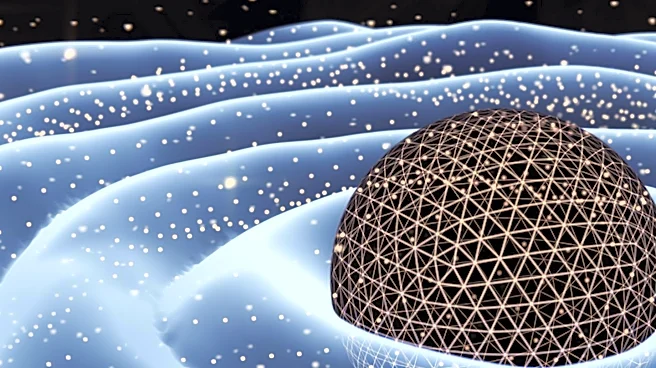
Later in the 19th century, another monumental realization emerged: it was possible to develop consistent geometries that did not rely on Euclid's parallel postulate. The parallel postulate, which states that through a point not on a given line, there is exactly one line parallel to the given line, had been a cornerstone of Euclidean geometry for millennia. Mathematicians had long attempted to prove it from Euclid's other axioms, but these efforts ultimately led to the discovery that denying the postulate could lead to equally valid and contradiction-free geometric systems.These non-Euclidean geometries represented a radical departure from the traditional understanding of space. They demonstrated that the properties of space were not necessarily fixed or singular, but could vary depending on the axioms chosen. A particularly famous and impactful application of non-Euclidean geometry is its role as the underlying geometric framework for Albert Einstein's theory of general relativity. This theory, which describes gravity as a curvature of spacetime, relies heavily on the concepts developed within non-Euclidean geometry, showcasing the profound real-world implications of these abstract mathematical discoveries. The ability to conceive of and work with spaces that deviate from Euclidean norms fundamentally transformed the landscape of geometry and its relationship to the physical universe.