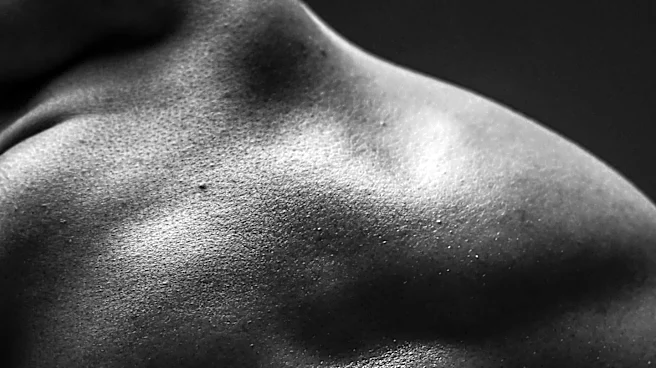









The deltoid muscle is a prominent feature of the human shoulder, forming its rounded contour. This muscle is not only crucial for various arm movements but also has a complex structure that allows it to perform its functions effectively. Understanding the deltoid muscle's anatomy provides insight into its role in human movement and its importance in maintaining shoulder stability.
The Three Parts of the Deltoid Muscle
The deltoid muscle is composed of three distinct sets of muscle fibers,
each contributing to different movements of the shoulder. These are the anterior deltoid, the posterior deltoid, and the intermediate deltoid. The anterior deltoid, also known as the clavicular part, originates from the anterior border and upper surface of the lateral third of the clavicle. This part of the muscle assists in shoulder flexion and works in tandem with other muscles to medially rotate the humerus.
The posterior deltoid, or scapular part, originates from the spine of the scapula. It plays a significant role in shoulder extension and works alongside the latissimus dorsi to extend the shoulder. The intermediate deltoid, also known as the acromial part, originates from the acromion. It is primarily responsible for shoulder abduction, especially when the shoulder is internally rotated.
The Role of the Deltoid in Shoulder Movement
The deltoid muscle is a key player in shoulder abduction, flexion, and extension. When all its fibers contract simultaneously, the deltoid acts as the prime mover of arm abduction along the frontal plane. This action is crucial for lifting the arm away from the body, a movement necessary for various daily activities.
The anterior fibers of the deltoid assist the pectoralis major in flexing the shoulder, while the posterior fibers aid in extending the shoulder. The intermediate fibers are particularly efficient in performing shoulder abduction, especially when the shoulder is internally rotated. This versatility in movement is what makes the deltoid muscle essential for the dynamic range of motion in the shoulder.
The Deltoid's Contribution to Shoulder Stability
Beyond facilitating movement, the deltoid muscle plays a vital role in maintaining shoulder stability. It helps prevent the dislocation of the humeral head, especially when carrying heavy loads. This function is crucial for activities that require carrying objects at a distance from the body, such as during a farmer's walk.
The deltoid's ability to elevate the arm in the scapular plane also contributes to the precise and rapid movement of the glenohumeral joint. This is essential for hand and arm manipulation, allowing for a wide range of activities. The muscle's structure and function are supported by the simultaneous contraction of other muscles, such as those in the rotator cuff, which help prevent injury and ensure smooth movement.