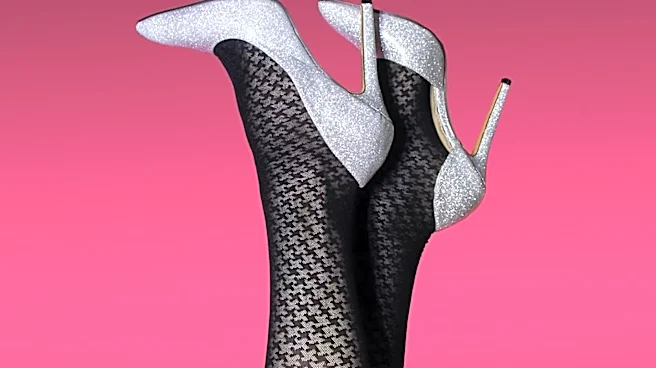









Stockings, known historically as hose, have undergone a significant transformation over centuries, evolving from practical garments worn by men in medieval times to the diverse fashion accessory primarily worn by women today. These close-fitting, elastic garments, which can cover the leg from the foot up to the knee, thigh, or even the hips, have seen changes in material, construction, and cultural significance. Their journey reflects shifts in clothing
technology, societal norms, and fashion trends, culminating in their current role as an aesthetic choice often paired with skirts.
Early Origins and Construction
Historically, the term "hose" was commonly used to refer to what men wore during the medieval period. The word "stock" itself originally referred to the lower "stump" part of the body. By analogy, this term came to describe the one-piece covering for the lower trunk and limbs in the 15th century. These early forms were essentially tights, composed of "upper-stocks," which later became separate knee breeches, and "nether-stocks," which evolved into what we now recognize as stockings.
Before the 1590s, stockings were either knitted by hand or constructed from woven cloth. Knitted stockings were generally preferred due to their inherent flexibility, offering a better fit and greater comfort. The materials used for these early stockings included cotton, linen, wool, or silk. Polished cotton, known as lisle, was a common choice, as were stockings produced in the town of Balbriggan, indicating specific regional manufacturing expertise.
Royal Fashion and Technological Advancements
The demand for specialized stockings was evident even in the 16th century. In 1560, merchant Thomas Gresham attempted to purchase silk hose for Elizabeth I in Antwerp. Unable to find any suitable options, he sent her measurements to Spain to have 20 pairs custom-made. A significant gift in January 1562 was a pair of "silk knytt hoose" given to Elizabeth I by Sybil Penn. These knitted silk stockings became a regular item, supplied in subsequent years by the queen's silkwoman, Alice Montague, highlighting their status as a luxury item.
The development of knitting machines marked a pivotal moment in the production of stockings. The very first knitting machines were specifically designed for making stockings, indicating the high demand and importance of this garment. This mechanization allowed for more efficient production, though the materials remained traditional for some time.
The 20th Century: Warmth, Sheerness, and Nylon
Before the 1920s, stockings, when worn, were primarily for warmth. However, the 1920s brought about a significant shift. As dress hemlines rose and central heating was not yet widespread, women began wearing flesh-colored stockings to cover their exposed legs. These stockings were sheer, initially made from silk or rayon, which was then referred to as "artificial silk." The landscape of hosiery changed dramatically after 1940 with the introduction of nylon.
DuPont's introduction of nylon in 1939 created an immense demand for stockings in the United States, with up to 4 million pairs sold in a single day. Nylon stockings were favored for being cheap, durable, and sheer, surpassing their cotton and silk predecessors. However, America's entry into World War II led DuPont to halt nylon stocking production, retooling factories for war materials like parachutes and airplane cords. This created a severe shortage and a black market for stockings. Post-war, DuPont struggled to meet renewed demand, leading to widespread disturbances in American stores known as the "nylon riots" until production could be scaled up.
Modern Decline and Alternatives
The mid-20th century saw the emergence of precursors to pantyhose. In the 1940s and 1950s, for film and theater productions, stockings were sewn directly to the briefs of actresses and dancers, as noted by Ann Miller and seen in films like *Daddy Long Legs*. Today, stockings are commonly made from knitted wool, silk, cotton, or nylon. The commercial introduction of pantyhose in 1959 offered a convenient alternative, causing a dramatic decline in stocking use. This shift was further propelled by the trend towards higher hemlines, such as the minidress. By 1970, U.S. sales of pantyhose surpassed stockings for the first time, a trend that has continued. While sales of pantyhose saw a slight decline starting in 1987 due to the invention of hold-ups, they still remain the most sold type of hosiery.