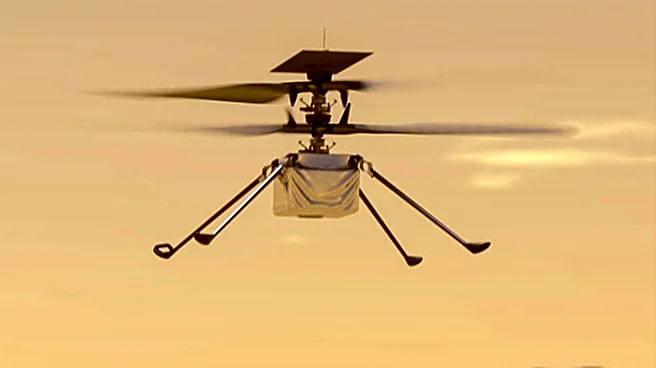







The Ingenuity helicopter, part of NASA's Mars 2020 mission, marks a historic milestone in space exploration as the first aircraft to achieve powered flight on another planet. This small, autonomous rotorcraft is a technological marvel, designed to test the feasibility of aerial exploration on Mars. This article delves into the design, mission, and significance of Ingenuity's flights on the Red Planet.
Design and Engineering
Ingenuity is a lightweight helicopter, weighing
just 1.8 kilograms (4 pounds), with a rotor system that spans 1.2 meters (4 feet). Its design is optimized for the thin Martian atmosphere, which is only about 1% as dense as Earth's. To achieve lift, Ingenuity's rotors spin at around 2,400 revolutions per minute, much faster than helicopters on Earth.
The helicopter is equipped with solar panels to recharge its batteries, allowing it to operate independently of the Perseverance rover. Ingenuity also features a suite of sensors, including a navigation camera, an altimeter, and an inertial measurement unit, which help it maintain stability and navigate during flight. The helicopter's design and engineering represent a significant achievement in adapting flight technology for the unique challenges of Mars.
Mission Objectives and Achievements
Ingenuity's primary mission is to demonstrate the feasibility of powered flight on Mars, paving the way for future aerial exploration. The helicopter's initial flights were short, lasting only a few seconds, but they provided valuable data on the performance of its systems in the Martian environment.
As the mission progressed, Ingenuity completed a series of increasingly complex flights, demonstrating its ability to fly longer distances and at higher altitudes. These flights showcased the helicopter's potential to assist future missions by scouting terrain, identifying hazards, and providing aerial perspectives that are not possible with rovers alone.
Significance and Future Implications
Ingenuity's successful flights on Mars have far-reaching implications for the future of space exploration. By proving that powered flight is possible on another planet, Ingenuity opens up new possibilities for exploring Mars and other celestial bodies with thin atmospheres.
The data collected by Ingenuity will inform the design of future aerial vehicles, which could play a crucial role in scientific exploration and even support human missions. Ingenuity's achievements are a testament to human innovation and the spirit of exploration, inspiring future generations to reach for the stars.