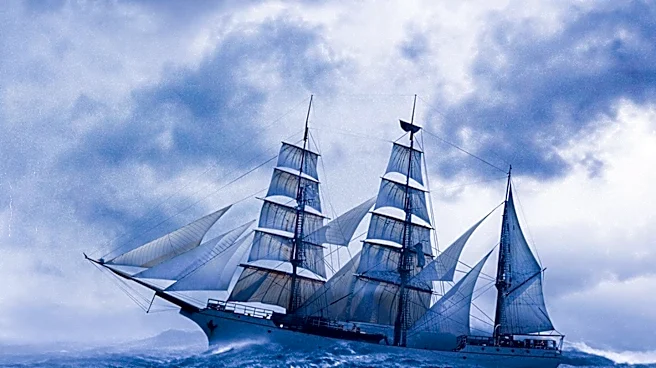






The American whaling ship *Essex*, launched in 1799 from Nantucket, Massachusetts, embarked on what was expected to be a profitable two-and-a-half-year voyage in August 1819. Considered a lucky vessel due to its previous successful expeditions, the *Essex* was relatively small for a whaler, measuring 88 feet in length and about 239 tons. Under the command of 29-year-old Captain George Pollard Jr., with a crew of twenty-one men, including 21-year-old
First Mate Owen Chase and 14-year-old cabin boy Thomas Nickerson, the ship set sail for the whaling grounds off the west coast of South America. This journey, however, would turn into one of the most harrowing tales of maritime disaster and human endurance, culminating in a struggle for survival against the vast, unforgiving Pacific Ocean.
Departure and Disaster in the Pacific
The *Essex* departed Nantucket on August 12, 1819. The crew included experienced whalers and young men, with at least five members under the age of 20. Captain Pollard had served on the *Essex* as second mate and first mate on previous voyages, as had Owen Chase. The second mate was Matthew Joy, 26, and the boatsteerers included Obed Hendricks, Benjamin Lawrence, and Thomas Chappel. The ship's initial journey was uneventful, but its fate took a dramatic turn on November 20, 1820. While in the southern Pacific Ocean, approximately 2,000 nautical miles from the coast of South America, the *Essex* was attacked and sunk by a sperm whale. This catastrophic event left the 20-man crew stranded in the open ocean, far from any known land.
Following the sinking, the crew spent two days salvaging what they could from the waterlogged wreck. They managed to rig three whaleboats with makeshift masts and sails from the *Essex*, and added boards to heighten the gunwales to protect against waves. Crucially, two sets of navigational equipment and two copies of Nathaniel Bowditch's *New American Practical Navigator* were saved from Captain Pollard's sea chest. These were divided between Pollard's and Chase's boats, leaving Joy's boat without independent navigation. The officers then debated their course. Captain Pollard favored sailing west towards the Marquesas or Society Islands, but Chase and Joy, fearing cannibals, advocated sailing south to pick up winds that would take them to Chile or Peru. Pollard ultimately agreed to the latter, a decision Herman Melville later speculated might have cost them their lives, suggesting they would have survived had they sailed directly to Tahiti.
The Perilous Journey to Henderson Island
On November 22, 1820, the crew, divided among the three boats commanded by Pollard, Chase, and Joy, set off. The whaleboats, never designed for long voyages, were roughly repaired and constantly leaked, requiring continuous bailing. Storms and rough seas were frequent challenges. Food and water were rationed from the outset, with the men first consuming seawater-soaked bread, which only increased their thirst. After ten days, they found a brief respite from hunger by slaughtering the first of the giant tortoises salvaged from the wreck.
Exactly one month after the whale attack, on December 20, the severely weakened crew, suffering from starvation, dehydration, and exposure, landed on Henderson Island. This uninhabited coral atoll, part of the modern-day British Pitcairn Islands, was mistakenly identified by the crew as Ducie Island. While they found birds, eggs, crabs, fish, and peppergrass for food, fresh water was scarce, though they eventually located a spring below the tideline. Within a week, the island's limited resources were largely depleted. On December 26, realizing they would starve if they remained, most of the crew prepared to depart. Three men—William Wright, Seth Weeks, and Thomas Chappel—chose to stay behind. Captain Pollard promised to arrange their rescue if he reached South America, a promise he kept, as they were rescued by the Australian trading vessel *Surry* in April 1821.
Separation, Starvation, and Rescue
The remaining seventeen crewmen resumed their journey on December 27, aiming for Easter Island. By January 4, 1821, they realized they had drifted too far south and changed course for Más Afuera Island off Chile. Their supply of food from Henderson Island ran out that day, returning them to meager rations. On January 10, Matthew Joy died and was buried at sea, with Obed Hendricks taking command of his boat. The next day, Chase's boat became separated from the others during a squall. The situation grew dire, leading to cannibalism on Pollard's and Hendricks's boats after Lawson Thomas died on January 20. Charles Shorter, Isaiah Sheppard, and Samuel Reed soon followed, their bodies consumed for survival. It was noted that the first four crew members eaten were African American, possibly due to their diet or differing body fat retention.
On January 29, Pollard's and Hendricks's boats separated. Hendricks's boat, lacking navigational equipment, was never seen again; a whaleboat with four skeletons found on Ducie Island months later was speculated to be theirs. By February 6, starvation again gripped Pollard's boat, leading to the drawing of lots, and Owen Coffin was shot and eaten. Five days later, Barzillai Ray died and was consumed. Meanwhile, on Chase's boat, Isaac Cole died on February 10, leading them to similar desperate measures. First Mate Chase later described the anguish of this dilemma.
Rescue finally came in February 1821. On February 18, Chase, Lawrence, and Nickerson were spotted by the British merchant ship *Indian* and rescued, too weak to climb aboard themselves. They were taken to Valparaíso, Chile. Five days later, on February 23, Pollard and Ramsdell were found near St. Mary's Island by the Nantucket whaleship *Dauphin*, barely alive and consuming marrow from their dead shipmates' bones. They were transferred to another whaler, *Two Brothers*, and reunited with Chase, Lawrence, and Nickerson in Valparaíso on March 17. All the survivors were Nantucketers. Chase, Lawrence, Nickerson, and Ramsdell departed for Nantucket on the whaleship *Eagle* on March 23, with Pollard following in May after recovering. The commander of the USS *Constellation* arranged the rescue of the three men left on Henderson Island, who were found by the *Surry* on April 9, 1821, bringing a close to one of the most tragic and compelling survival stories in maritime history.