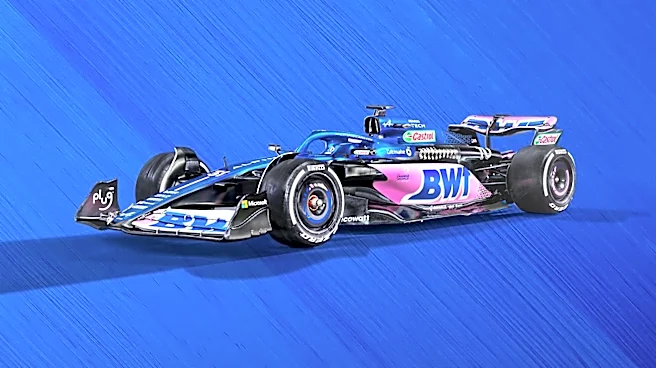






The Alpine F1 Team, known in its current form as BWT Alpine F1 Team, carries a rich history of innovation and competitive spirit in Formula 1. Tracing its roots back to Renault's initial entry into the sport, the team has consistently pushed technological boundaries, particularly in engine development, and has achieved notable successes on the track. From pioneering turbo engines to securing championship titles as an engine supplier, the team's journey
is marked by a relentless pursuit of performance.
Pioneering Turbo Technology and Early Successes
Renault's initial foray into Formula 1 in 1977 was revolutionary, primarily due to its introduction of the turbocharged engine. While competitors used larger 3,000 cm³ engines, Renault's RS01 featured a 1,500 cm³ turbocharged engine, a bold move that initially faced skepticism and reliability issues. The car, nicknamed the "Yellow Tea Pot" by the British due often finishing races in a cloud of smoke, eventually proved the viability of turbocharging. By 1979, the team, then known as Renault-Elf, began to see success, with Jean-Pierre Jabouille securing the team's first Grand Prix victory at Dijon-Prenois, France. This victory, achieved with a V6 1,500 cm³ turbocharged engine, demonstrated the dominance of turbo technology over the larger V8 and V12 atmospheric engines of the era. This success led to other teams adopting turbocharged engines, a testament to Renault's pioneering spirit.
Throughout the early 1980s, Renault continued to be a strong contender. In 1982, the RE30B secured four Grand Prix wins, contributing to the team's third-place finish in the constructors' championship. The following year, with Alain Prost joining the team, Renault was a strong contender for the world title, winning four races. Despite reliability issues and internal tensions, Prost finished second in the drivers' championship, and Renault secured second place in the constructors' standings. These early years established Renault's reputation for innovative engine design and competitive racing.
Engine Supply Dominance and Championship Victories
After a period as a full constructor, Renault transitioned to primarily being an engine supplier in the late 1980s and 1990s. This era proved to be incredibly successful, with Renault engines dominating the sport. Developing a V10 atmospheric engine in anticipation of the turbo ban in 1989, Renault quickly became the leading engine manufacturer. This V10 engine, featuring pneumatic valve recall technology, powered teams like Williams F1 Team and Benetton Formula to multiple championships. Between 1992 and 1997, Renault engines were associated with eleven world titles, including six constructors' titles and five drivers' titles for Williams and Benetton.
This period of engine supply dominance showcased Renault's engineering prowess and its ability to provide championship-winning power units. Even after officially withdrawing as a factory team in 1997, Renault engines, supplied through subcontractors like Mecachrome, continued to be used by various teams until 2000. The success as an engine supplier ultimately fueled the desire for a full factory return, leading to the acquisition of the Benetton team in 2000 and the eventual rebranding as Alpine F1 Team. This continuous cycle of innovation, competition, and strategic evolution defines the legacy of the Alpine F1 Team in Formula 1.