
Michael Phelps's name is synonymous with swimming excellence, and his early career was a testament to his burgeoning dominance on the international stage. Beyond his Olympic achievements, Phelps consistently showcased his extraordinary talent and versatility at major global competitions, including the Pan Pacific Championships and the World Championships. These events provided the arena for him to not only collect numerous medals but also to repeatedly
shatter world records, solidifying his reputation as a formidable force in competitive swimming.
Pan Pacific Championships 2002: A Glimpse of Versatility
The 2002 Pan Pacific Championships in Yokohama, Japan, offered an early demonstration of Phelps's remarkable range and competitive spirit. At the national trials for this event in Fort Lauderdale, he had already set a national record in the 200-meter individual medley and came close to doing so in the 200-meter butterfly. Notably, in the 400-meter individual medley, he surpassed Tom Dolan's world record with a time of 4:11.09, with Erik Vendt also finishing below the previous world record. Phelps also secured a national record in the 100-meter butterfly, outperforming Ian Crocker.
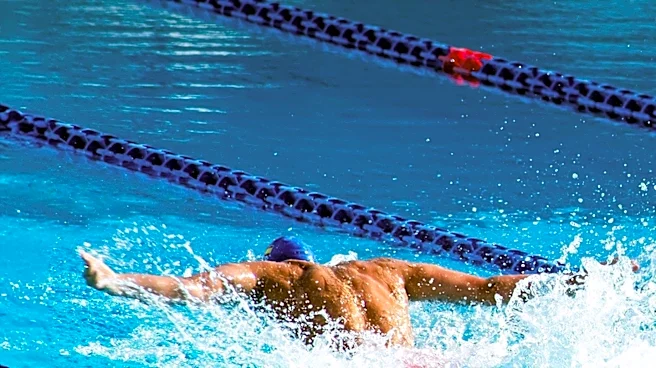
At the championships themselves, Phelps earned three gold medals and two silver medals. He dominated the 400-meter individual medley, winning with a time of 4:12.48, ahead of Erik Vendt. In the 200-meter butterfly, he took silver, losing to Tom Malchow, and later admitted he hadn't taken butterfly training seriously after breaking the world record. He secured another gold in the 200-meter individual medley with a time of 1:59.70. Phelps also contributed to a silver medal in the 4x200-meter freestyle relay and was part of the 4x100-meter medley relay team that set a new world record of 3:33.48, with his butterfly leg clocked at an astonishing 51.1 seconds, then the fastest in history.
World Championships 2003: Record-Breaking Feats in Barcelona
The 2003 World Championships in Barcelona, Spain, marked a significant milestone in Phelps's career, where he delivered an astounding performance, securing four gold medals, two silver medals, and setting five world records. His campaign began with the 200-meter butterfly, where he broke his own world record in the semifinals with a time of 1:53.93, becoming the first swimmer to dip below 1:54.00. He went on to win the gold medal in the final with a time of 1:54.35. Less than an hour later, he swam the lead-off leg of the 4x200-meter freestyle relay, setting a new national record with 1:46.60, contributing to a silver medal for the American team.
Phelps continued his relentless pursuit of records in the 200-meter individual medley. He broke his own world record in the semifinals with 1:57.52, and then again in the final with an incredible 1:56.04, winning gold by nearly three seconds over Ian Thorpe. Before this final, he had also set a world record in the 100-meter butterfly semifinals with 51.47 seconds. Although he earned a silver medal in the final of the 100-meter butterfly, as Ian Crocker broke the world record with 50.98 seconds, Phelps's time of 51.10 was also under the previous world record. He concluded his individual events by breaking his own world record in the 400-meter individual medley with 4:09.09, earning another gold, and received a gold medal for participating in the preliminary heats of the 4x100-meter medley relay.
Montreal 2005: Strategic Shifts and Continued Success
By the 2005 World Championships in Montreal, Phelps began to strategically adjust his event selection, opting out of his traditionally strongest events, the 400-meter individual medley and 200-meter butterfly, to explore the 100-meter and 400-meter freestyle. This experimentation proved successful in the trials, where he won the 100-meter, 200-meter, and 400-meter freestyle, along with the 100-meter butterfly and 200-meter individual medley.
At the championships, Phelps secured five gold medals and one silver. Despite not advancing past the preliminary phase in the 400-meter freestyle, placing 18th, he quickly rebounded. He earned his first gold in the 4x100-meter freestyle relay, setting a new championship record. Two days later, he claimed another gold in the 200-meter freestyle with a new national record of 1:45.20, finishing ahead of Grant Hackett. He then won his third gold in the 200-meter individual medley. Phelps also contributed to a gold medal in the 4x200-meter freestyle relay, which recorded the second-fastest time in history. His only silver medal came in the 100-meter butterfly, where he was outpaced by Ian Crocker, who broke his own world record. Phelps still received a gold medal for his participation in the preliminary heats of the 4x100-meter medley relay, capping off another highly successful championship performance.