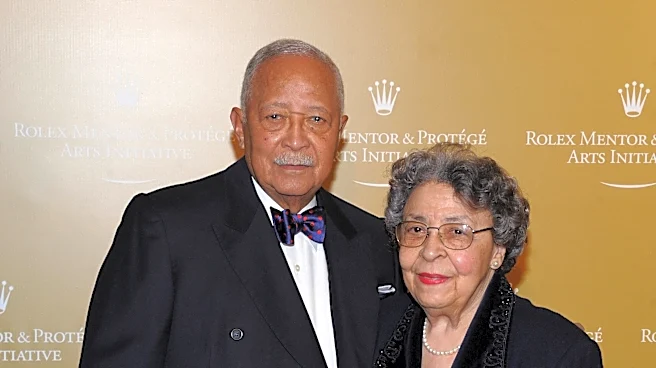
David Dinkins, born on July 10, 1927, in Trenton, New Jersey, was a significant figure in American politics, particularly within New York City. His career culminated in his historic election as the 107th mayor of New York City, a position he held from 1990 to 1993. Dinkins was the first African American to serve as the city's mayor, marking a pivotal moment in its political history. His journey through various public offices and his eventual rise
to the city's highest political post underscore a career dedicated to public service and breaking racial barriers.
Early Life and Education
Born in Trenton, New Jersey, David Dinkins pursued higher education, attending Howard University and later Brooklyn Law School. These academic foundations provided him with the knowledge and skills that would prove essential in his subsequent political and legal career. His early life experiences and educational background laid the groundwork for his future endeavors in public service, shaping his perspective and commitment to community engagement. His path from a New Jersey native to a prominent New York City politician highlights a trajectory of dedication and perseverance.
Early Political Engagements and the "Gang of Four"
Dinkins' political career began to take shape with his first political mandate from 1965 to 1967, serving as a deputy in the New York State Assembly. Following this, he held several administrative positions within New York City's government. He was also part of an influential African-American political coalition from Harlem known as the "Gang of Four," or the Harlem Clubhouse. This group, whose members later ascended to top political posts, included figures like Basil Paterson, Percy Sutton, and Charles Rangel. J. Raymond Jones played a significant role in helping these men achieve power. Dinkins' involvement with this group demonstrates his early connections and influence within the African-American political landscape of New York.
Rise to Borough President and Mayoral Election
In 1985, Dinkins was elected as the Borough President of Manhattan, succeeding Andrew Stein, after his third attempt at the position. He held this post from 1986 to 1989. His tenure as Borough President served as a crucial stepping stone to his mayoral aspirations. On November 7, 1989, as the Democratic candidate, he successfully ran for Mayor of New York, defeating Republican Rudy Giuliani with a narrow margin. This victory was historic, making him the first African American mayor of the city. His election was seen by some as an opportunity to ease community tensions, given his calm demeanor and his status as the city's first Black mayor.
Mayoral Term and Legacy
David Dinkins' mayoral term, from January 1, 1990, to December 31, 1993, was marked by both challenges and achievements. He began his term by promising to address issues of racism within what he called a "gorgeous mosaic" of communities. During his time in office, Dinkins was credited with being the first in the city's history to halt the rising crime spiral, achieving a nearly 25 percent increase in police personnel. However, his term also saw significant events such as the Crown Heights riots and a boycott of a Korean store in Flatbush, Brooklyn. Despite these challenges, his diplomatic qualities, initially seen as an advantage, were sometimes perceived as a weakness during crises. He was succeeded by Rudy Giuliani in 1993, making Dinkins the last Democratic mayor until Bill de Blasio's election in November 2013. Dinkins passed away on November 23, 2020, in New York City.