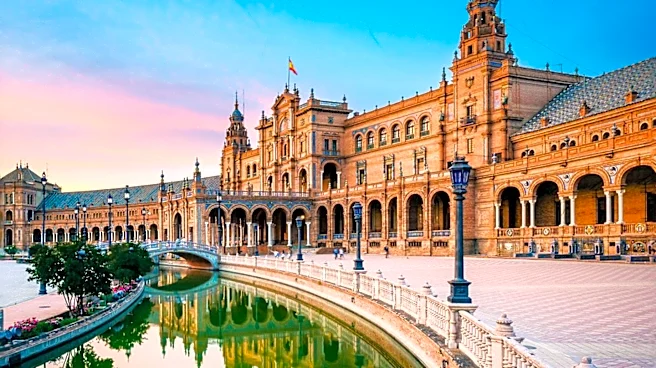





Seville, a city in Andalusia, Spain, boasts a rich and complex history spanning approximately 2,200 years. Its strategic location on the lower reaches of the River Guadalquivir in the southwest of the Iberian Peninsula has made it a coveted center for various civilizations. Each ruling power, from the Romans to the Islamic caliphates and the Crown of Castile, left an indelible mark, shaping Seville into a city with a distinct personality and a remarkably
well-preserved historical core. This continuous layering of cultures and architectural styles is a defining characteristic of Seville's identity, evident in its ancient structures and modern-day charm.
From Roman Hispalis to Islamic Ishbiliyah
Seville's origins trace back to its founding as the Roman city of Hispalis. During Roman rule, the name was Latinized as Hispal and later Hispalis. Following the Umayyad invasion in 711, the city became known as Ishbiliyah. The /p/ phoneme, absent in Arabic, was replaced by /b/, and the Latin place-name suffix -is was Arabized as -iya, with a phonetic shift from /æ/ to /iː/. This transformation reflects the profound cultural and linguistic changes that swept through the region with the arrival of Islamic rule. The city's name, "Sevilla," is believed by some to derive from the ancient Phoenician name Spal, meaning "lowland," or from Hisbaal, potentially referring to the god Baal, suggesting even earlier influences on its nomenclature.
After the collapse of the Caliphate of Córdoba in the early 11th century, Ishbiliyah emerged as the center of the independent Taifa of Seville. This period saw significant development, particularly under the Abbadid dynasty in the 11th century, which expanded the Alcázar complex southwards and eastwards. The Abbadid ruler al-Mu'tamid added a new southern enclosure, measuring approximately 70 by 80 meters, and named this new palace al-Mubarak, meaning "the Blessed." Various additions, such as stables and warehouses, were also constructed during this time, indicating a flourishing and expanding city under Islamic rule.
The Almohad Era and Castilian Conquest
Towards 1150, the Almohad Caliphate further developed Seville as their capital in al-Andalus. The Almohad governor significantly extended the fortified complex to the west, nearly doubling its size. At least six new courtyard palaces were built within the old enclosures, and nine more were added in the western extensions. In 1163, Caliph Abu Yaʿqub Yusuf made the Alcázar his main residence in the region, further expanding and embellishing the palace complex in 1169. This involved adding six new enclosures to the north, south, and west sides of the existing palaces, with architects Ahmad Ben Baso and Ali al-Ghumari overseeing the works. Most previous buildings were demolished to make way for approximately twelve new palaces, including a large garden courtyard now known as the Patio del Crucero.
Seville's Islamic era concluded with its conquest by Ferdinand III of Castile in 1248. This event marked a pivotal turning point, as the former Moorish palace-citadel was taken over by the Castilian monarchs and underwent substantial reconstruction and modification. While much of the Islamic-era structure has since disappeared, remnants like archaeological remains of the Al Mubarak Palace under the Patio de la Monteria and wall painting fragments exhibited in the Palacio del Yeso offer glimpses into its past. The Patio del Yeso, Palacio de la Contratación, and Patio del Crucero still preserve elements from the Almohad period, serving as tangible links to Seville's diverse historical tapestry.
Gateway to the New World and Modern Identity
In the 16th century, Seville's role as the gateway for the Spanish Empire's trans-Atlantic trade, managed from the Casa de Contratación, propelled it to become one of Western Europe's largest cities. This period of immense prosperity and global connection further cemented Seville's importance on the world stage. However, a deterioration in drought conditions in the Guadalquivir River gradually shifted American trade away from Seville, first to downstream berths and eventually to the Bay of Cádiz. Despite this shift, the city's historical significance as a hub of exploration and commerce remains a crucial part of its narrative.
Today, Seville continues to be the capital and largest city of the Spanish autonomous community of Andalusia and the province of Seville. Its official motto, NO8DO, popularly interpreted as "She [Seville] has not abandoned me," is a testament to its enduring spirit and the loyalty of its citizens, particularly during the time of King Alfonso X. This motto, along with its ancient foundations and layered history, contributes to Seville's unique cultural identity, making it a city where the past is always present.