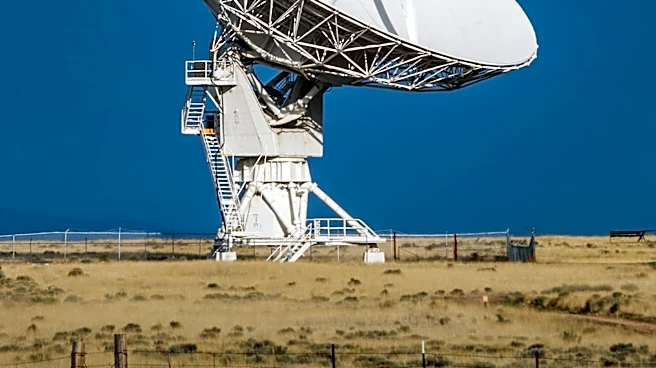









The Karl G. Jansky Very Large Array (VLA), located in the Plains of San Agustin, New Mexico, represents a significant achievement in radio astronomy engineering. This observatory, officially named in 2012, is not a single monolithic instrument but a complex system of 28 radio telescopes working in concert. Each telescope boasts a 25-meter dish diameter and is integrated into a sophisticated Y-shaped array. This design allows the VLA to function as an interferometer,
a technique that combines signals from multiple antennas to achieve the resolution of a much larger, single dish.
The Mechanics of the Y-Shaped Array
The core of the VLA's engineering lies in its unique Y-shaped configuration. This array consists of three arms, each stretching 21 kilometers (13 miles) in length. Along these arms, 27 operational antennas (with one spare for maintenance) are strategically positioned. Each antenna is a substantial piece of equipment, weighing 209 metric tons (230 short tons), and is mounted on double parallel railroad tracks. These tracks are not merely for static placement; they are integral to the VLA's operational flexibility.
The ability to relocate these massive antennas is a defining characteristic of the VLA. A specialized lifting locomotive, affectionately known as "Hein's Trein," is employed to move the antennas to various prepared positions along the tracks. This mobility allows astronomers to dynamically adjust the array's radius and density. By changing the separation between the antennas, the VLA can effectively alter its "aperture," enabling it to achieve different balances between angular resolution and surface brightness sensitivity, depending on the specific astronomical observation being conducted.
Interferometry and Resolution Capabilities
The principle of interferometry is central to the VLA's power. By combining the signals from its multiple antennas, the array synthesizes the data to mimic a single, enormous telescope. This technique allows the VLA to achieve an angular resolution equivalent to that of a telescope with a diameter equal to the maximum separation between its antennas. In its largest configuration, the VLA can achieve an angular resolution of approximately 0.05 arcseconds, which is exceptionally precise for radio astronomy.
The VLA's design allows for up to 351 independent baselines, which are the unique pairs of antennas whose signals are combined. This extensive number of baselines contributes to the high-resolution images and data the observatory produces. The system operates across centimeter wavelengths, making it a highly sensitive radio interferometer for this frequency range. This intricate engineering enables the VLA to probe the universe with remarkable detail, from the structure of distant galaxies to the dynamics of gas within our own Milky Way.
Operational Context and Maintenance
Operating at an altitude of 2124 meters (approximately 6969 feet), the VLA is part of the National Radio Astronomy Observatory (NRAO). The continuous operation of such a complex system requires ongoing maintenance, which is why one of the 28 telescopes is always rotating through a maintenance cycle. This ensures that 27 antennas are consistently available for scientific observations. The VLA's robust infrastructure, including its rail system and specialized transport, underscores the significant engineering effort invested in its construction and upkeep, making it a cornerstone of modern radio astronomy.