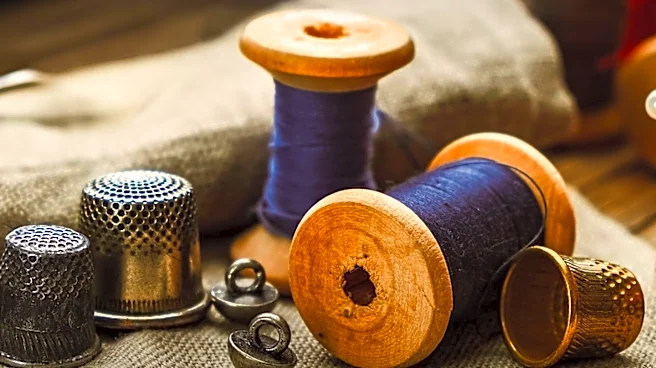






A thimble, a small pitted cup worn on the finger, serves a fundamental purpose: to protect the finger from being pricked or poked by a needle during sewing. This seemingly simple tool boasts a rich history, evolving from its likely origins alongside the invention of sewing to becoming a widespread item by the Middle Ages. Its journey through time has seen it transform from a purely utilitarian object into a symbol, a collectible, and even a subject
of cultural references, reflecting changes in manufacturing, societal customs, and artistic expression.
Early Origins and Widespread Use
The precise moment of the thimble's invention is lost to history, but its purpose suggests it emerged closely following the development of sewing itself. As long as people have used needles to join fabrics or leather, the need for finger protection would have been apparent. Archaeological evidence supports this ancient lineage, with thimbles dating back to the 10th century having been discovered in England. By the 14th century, their use was already widespread across the region, indicating their established role in daily life.
Early thimbles were primarily crafted from brass, a common material in brass-working centers. Nuremberg, in the 15th century, was an early hub for thimble production, a role that later shifted to Holland by the 17th century. These medieval thimbles were either cast brass or formed from hammered sheets of metal. The manufacturing process for these early thimbles involved hand-punching the small dimples on their exterior, a labor-intensive method that would persist for centuries.
Evolution in Manufacturing and Materials
The 17th century marked a significant period of expansion for thimble production, particularly in Britain. In 1693, John Lofting, a Dutch thimble manufacturer, established a manufactory in Islington, London, which greatly boosted British output. He later relocated his mill to Buckinghamshire to leverage water-powered production, dramatically increasing capacity to over two million thimbles annually. This mechanization began to change the thimble's form and consistency.
By the end of the 18th century, thimble making had moved to Birmingham and adopted the "deep drawing" method. This technique involved alternating hammering of sheet metals with annealing, resulting in a thinner-skinned, taller thimble. Concurrently, the availability of cheaper silver from the Americas made silver thimbles a popular item for the first time. While precious metal thimbles, such as one reportedly given by Elizabeth I adorned with jewels, existed earlier, brass remained the predominant material for most metal thimbles until these manufacturing and material shifts.
Thimbles in Culture and Collectibles
Beyond their practical use, thimbles have woven their way into various cultural contexts. From the 16th century onward, silver thimbles became a favored gift for ladies. Elaborate gold thimbles and early Meissen porcelain thimbles were also given as keepsakes, often being too delicate for actual sewing. This tradition of thimbles as commemorative or decorative items continues today. In the early modern period, thimbles were even used to measure spirits and gunpowder, giving rise to the phrase "just a thimbleful." They also had more unusual uses, such as in "thimble-knocking" by prostitutes to announce their presence or by Victorian schoolmistresses tapping unruly pupils.
Collecting thimbles, known as digitabulism, gained popularity in the UK, especially after companies created special thimbles to commemorate the Great Exhibition in London. The issue of silver's softness, which made it easily punctured by needles, was addressed by Charles Horner, who developed the "Dorcas" thimble. This innovative design featured a steel core covered in silver, combining aesthetics with durability, and these are now sought after by collectors. Rare American thimbles made from whale bone or tooth, featuring miniature scrimshaw designs, are also highly valued collectibles and are displayed in New England Whaling Museums. During World War I, silver thimbles were collected by the British government and melted down for hospital equipment, highlighting their intrinsic value. In the 1930s and 1940s, glass-topped thimbles were used for advertising, and sandalwood thimbles were left in fabric stores to deter moths. Thimbles have also served as love-tokens and commemorative items, further cementing their diverse cultural footprint.