



STS-61-B, the 23rd NASA Space Shuttle mission, launched on November 26, 1985, aboard Space Shuttle Atlantis, was notable for its pioneering efforts in orbital construction and its international crew. Beyond deploying critical communications satellites, the mission actively tested techniques for building structures in the challenging environment of space. This forward-looking aspect of the mission provided crucial data for the future of human spaceflight
and the potential assembly of larger space stations. Additionally, the mission carried Rodolfo Neri Vela, the first Mexican astronaut, highlighting a growing international dimension in space exploration.
Pioneering In-Orbit Construction Experiments
A key element of STS-61-B's objectives was the EASE/ACCESS experiment, a collaborative effort between the Langley Research Center (LRC) and the Marshall Space Flight Center (MSFC). This experiment was designed to assess the feasibility of assembling large structures in space. ACCESS, one component of the experiment, involved a "high-rise" tower constructed from numerous small struts and nodes. EASE, the other component, was a geometric structure resembling an inverted pyramid, built from a few large beams and nodes. Together, these experiments aimed to demonstrate that preformed structures could be effectively assembled in the microgravity environment of orbit.
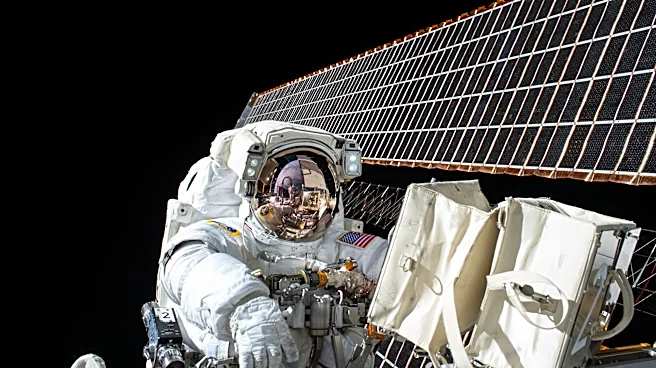
Astronauts Jerry Ross and Sherwood Spring conducted two spacewalks, or Extravehicular Activities (EVAs), to perform the EASE/ACCESS work. These spacewalks were significant, marking the 50th and 51st EVAs for the United States and the 12th and 13th for the Shuttle program. An IMAX camera, mounted in the cargo bay, captured footage of the astronauts engaged in these construction activities, as well as other scenes of interest. The astronauts reported that the most challenging aspect of the spacewalks was torquing their own masses while holding the EASE beams. They found that ACCESS functioned well, but EASE required too much free-floating movement. The crew concluded that performing six-hour spacewalks every other day over a five or six-day period was feasible, and they recommended glove changes to reduce hand fatigue.
International Presence and Scientific Endeavors
STS-61-B was also notable for carrying Rodolfo Neri Vela, the first Mexican astronaut, into space. During the mission, Neri Vela conducted a series of experiments primarily focused on human physiology. He also contributed to the mission's Earth observations by photographing Mexico and Mexico City. This inclusion of an international astronaut underscored the expanding global participation in space missions, paving the way for more diverse crews in subsequent years.
In addition to the construction experiments and international participation, the mission included other scientific and commercial activities. Astronaut Charles Walker once again operated the Continuous Flow Electrophoresis System (CFES), marking its third flight with larger and improved equipment. This system was used to produce commercial pharmaceutical products in microgravity. Another experiment, Diffusive Mixing of Organic Solutions (DMOS), was successfully conducted for 3M, with the goal of growing single crystals that were larger and purer than those achievable on Earth. A Getaway Special (GAS) canister in Atlantis's payload bay carried a Canadian student experiment, which involved the fabrication of mirrors in microgravity, aiming for higher performance than Earth-made counterparts.
Mission Conclusion and Future Implications
All experiments on STS-61-B were successfully accomplished, and all equipment operated within established parameters. Atlantis landed safely at Edwards Air Force Base, California, on December 3, 1985, after a mission lasting 6 days, 21 hours, 4 minutes, and 49 seconds. The insights gained from the EASE/ACCESS experiments, particularly the challenges and successes of in-orbit assembly, provided valuable lessons for the design and construction of future space infrastructure. Astronaut Ross, reflecting on EASE, later commented that it was "probably not the preferred way of building a space station," suggesting that while the concept was proven, the methods needed refinement. He also noted the potential utility of the Manned Maneuvering Unit (MMU) for certain construction applications, such as moving components beyond the reach of the manipulator arm or attaching cable runs and instruments in inaccessible areas. The mission's blend of satellite deployment, pioneering construction tests, and international crew participation made it a significant step in the evolution of the Space Shuttle program.