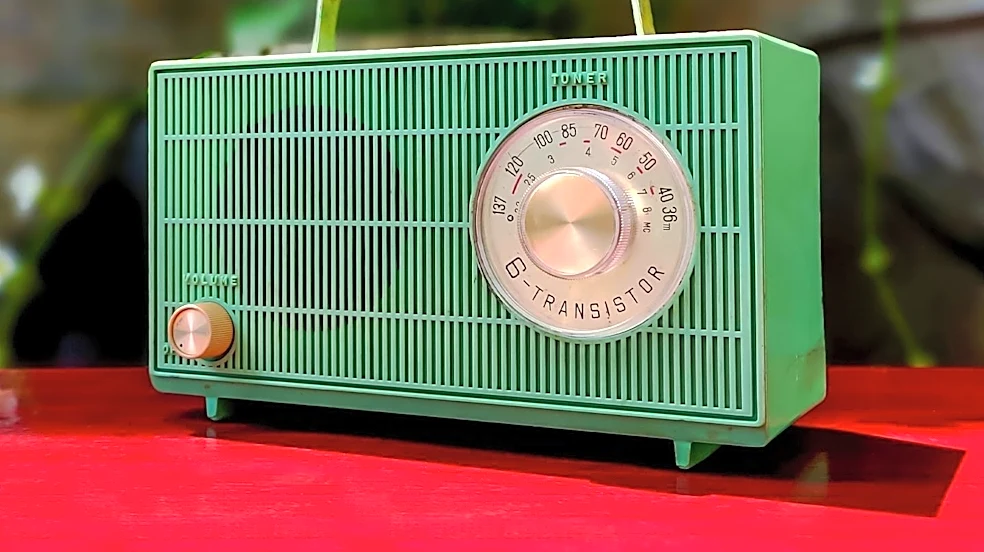










The Regency TR-1, introduced in 1954, marked a significant turning point in consumer electronics as the world's first commercially available transistor radio. This compact device, a product of collaboration between Texas Instruments and Industrial Development Engineering Associates (I.D.E.A.), ushered in an era of portable communication that would profoundly impact daily life. Its arrival challenged the dominance of bulky vacuum tube radios and set
a new standard for miniaturization and convenience, even as it faced initial challenges in sound quality and market acceptance.
Conception and Collaboration
The development of the Regency TR-1 was a strategic move by Texas Instruments to find a market for its newly developed transistors. In May 1954, Texas Instruments had already designed and built a prototype and was actively seeking an established radio manufacturer to develop and market a radio utilizing their transistors. Interestingly, major radio makers of the time, including RCA, GE, Philco, and Emerson, showed no interest in this new technology.
It was Ed Tudor, the President of I.D.E.A., who recognized the potential. I.D.E.A., previously known for building home television antenna boosters, partnered with Texas Instruments, which had a background in instrumentation for the oil industry and locating devices for the U.S. Navy. This collaboration aimed to grow revenues for both companies by venturing into the nascent transistor radio market. Richard C. Koch, Project Engineer at I.D.E.A., was instrumental in the patenting of the Regency TR-1.
Technical Design and Features
The TR-1 was engineered as a superheterodyne receiver, incorporating four n-p-n germanium transistors and one diode. Its circuit design included a single transistor converter stage, followed by two intermediate-frequency amplifier stages. After detection, a final single-transistor stage amplified the audio frequency. All amplifier stages employed common emitter amplifiers, and the stages were transformer coupled, utilizing tuned transformers for the intermediate frequency amplifiers and a miniature audio transformer for the loudspeaker.
Powering this innovative device was a 22.5-volt battery, chosen because early transistors required operation close to their collector-to-emitter breakdown voltage to achieve adequate radio frequency performance. Despite the high voltage, the current drain was remarkably low, only 4 mA, allowing for 20 to 30 hours of operation. This was a significant improvement over portable receivers based on vacuum tubes, which typically offered only several hours of battery life. The intermediate frequency transformers were paired with capacitors and hand-tuned to 262 kHz using movable cores. The receiver also featured automatic gain control, where the DC level of the detected signal was filtered with a large capacitor and used to control the gain of the first IF stage.
Aesthetics and Market Introduction
The physical design of the TR-1 was compact, measuring 3" × 5" × 1.25" (7.62 × 12.7 × 3.2 cm) and weighing 12 ounces (340 g) including its 22.5-volt battery. It was initially offered in a range of colors: black, bone white, mandarin red, and cloud gray. Later, less common colors like olive green and mahogany were introduced, followed by rare options such as lavender, pearl white, turquoise, pink, and lime. Each radio came in a cardboard box with its color stamped on the end, and an optional earphone was available for $7.50.
The Regency TR-1 was officially announced on October 18, 1954, with the slogan "See it! Hear it! Get it!" and went on sale in November 1954, just in time for the holiday season. Priced at $49.95, it sold approximately 100,000 units within a year. Despite its innovative nature and compact size, early reviews often noted its poor sound quality due to having only four transistors. The frequency dial also featured red triangles marking the CONELRAD frequencies of 640 and 1240 kHz, a detail reflecting the Cold War era.