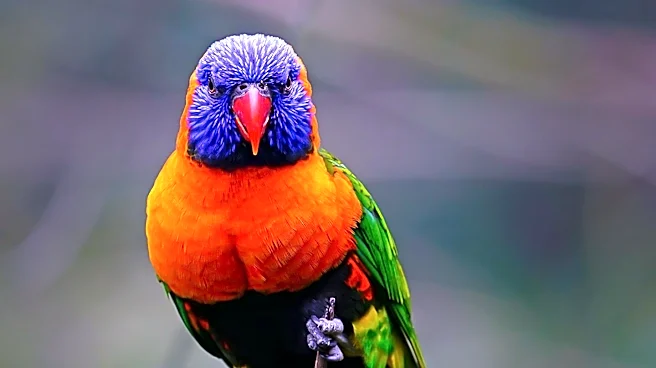

The rainbow lorikeet, scientifically known as *Trichoglossus moluccanus*, is a vibrant species of parrot native to Australia. This medium-sized bird is commonly found along the eastern seaboard of the continent,
stretching from northern Queensland down to South Australia. Its natural habitats include rainforests, coastal bush, and woodland areas. Beyond its native range, the rainbow lorikeet has also established populations in various other regions, including Perth, Western Australia; Tasmania; Auckland, New Zealand; and Hong Kong, highlighting its adaptability and capacity to thrive in new environments.
Physical Characteristics and Identification
The rainbow lorikeet is easily recognizable by its strikingly colorful plumage. Measuring between 9.8 to 11.8 inches (25 to 30 cm) in length, including its tail, and weighing from 2.6 to 5.5 ounces (75 to 157 g), it is a moderately sized parrot. The head of the bird is a deep blue, complemented by a greenish-yellow collar around its neck. The rest of its upper body, encompassing the wings, back, and tail, is green. Its chest displays a mix of orange and yellow, while the belly is a deep blue, and the thighs and rump are green. When in flight, a distinct yellow wing-bar stands out against the red underwing coverts.
Visually distinguishing between male and female rainbow lorikeets is challenging, as they exhibit no immediately discernible dimorphic traits. Unlike some other parrot species, both sexes appear identical. To determine an individual's sex, methods such as surgical sexing by a veterinarian or DNA analysis of a feather are typically employed. Juveniles can be identified by their black beaks, which gradually transition to an orange color as they mature into adults. The markings of *T. moluccanus* bear a resemblance to those of the coconut lorikeet (*T. haematodus*), but the rainbow lorikeet is characterized by a blue belly and a more orange breast, often with minimal or no blue-black barring.
Breeding Habits and Nesting
In southern Australia, the breeding season for rainbow lorikeets generally spans from late winter to early summer, specifically from August to January. However, across other parts of Australia, breeding has been observed in every month except March, with variations influenced by the availability of food and climatic conditions in different regions. These adaptable birds utilize a variety of nesting sites, which can include hollows within tall trees, such as eucalypts, palm trunks, or even overhanging rock formations. Interestingly, one population in the Admiralty Islands has been noted to nest in holes in the ground on islets that are free from predators.
Rainbow lorikeet pairs sometimes choose to nest in the same tree as other rainbow lorikeet pairs or even alongside other bird species. A typical clutch consists of one to three eggs, which are incubated for approximately 25 days. The incubation duties are carried out solely by the female. Rainbow lorikeets are largely monogamous, tending to remain paired for extended periods, often for their entire lives, demonstrating a strong pair bond within the species.