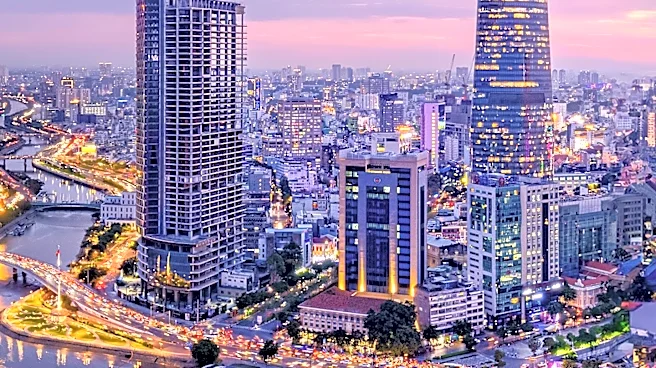

Ho Chi Minh City, Vietnam's most populous urban center, is a place rich with history and a complex identity, reflected in its various names. While officially known as Ho Chi Minh City since 1976, its former
name, Saigon, continues to resonate deeply both within Vietnam and internationally. This duality in naming speaks to a layered past, from its origins as a Khmer port to its pivotal role in French colonial history and the Vietnam War. The city's evolution is not just a story of urban development but also a narrative of cultural shifts, political transformations, and the enduring power of historical memory embedded in its very nomenclature.
From Prey Nokor to Saigon: Early Transformations
The area that is now Ho Chi Minh City began as a Khmer port city known as Prey Nokor, which translates to "Jungle City." This early settlement was gradually inhabited by Vietnamese refugees starting in the 1620s, fleeing conflicts further north. By 1623, the Khmer King Chey Chettha II permitted Vietnamese settlement and the establishment of a custom house at Prey Nokor. Over time, the increasing influx of Vietnamese settlers, coupled with the Khmer kingdom's weakening due to wars with Thailand, led to the Vietnamization of the area. The Vietnamese colloquially referred to this growing settlement as Sài Gòn.
When the French invaded in 1859 during the Cochinchina Campaign, they officially westernized the city's traditional name to "Saigon." Under French rule, Saigon became the capital of French Indochina and a crucial hub for colonial trade. This period solidified Saigon's image as a significant urban center, marked by European architecture and a distinct French atmosphere. Even after Vietnam gained independence from France, Saigon served as the capital of the Republic of Vietnam from 1954 until 1975, further cementing its identity under that name.
The Renaming of Saigon: A Post-War Identity
The most significant name change occurred after the fall of Saigon on April 30, 1975, marking the end of the Vietnam War. The city was subsequently renamed Ho Chi Minh City to honor Hồ Chí Minh, the first leader of the Democratic Republic of Vietnam. This renaming was formalized on July 2, 1976, with the establishment of the modern-day Socialist Republic of Vietnam. The tradition of naming places after significant national figures is common in Vietnam, with many streets bearing the names of epic heroes, such as Hai Ba Trung street, named after heroic sisters.
Despite the official change, the informal name of Sài Gòn has persisted in daily speech, both domestically and internationally. Many Vietnamese people, as well as those from other countries, continue to refer to the city as "Saigon." This enduring usage is evident in various aspects of city life; for instance, the Saigon River and the Saigon railway station have retained their original names. Even the IATA code for Tân Sơn Nhất International Airport remains SGN, and the city's official seal incorporates both names. This continued use of "Saigon" highlights a cultural attachment and historical continuity that transcends official decrees, particularly among the Vietnamese diaspora and local residents.
A City of Dual Names: Modern Usage and Cultural Significance
The coexistence of both names, Ho Chi Minh City and Saigon, reflects a unique aspect of the city's identity. While official documents and formal contexts use Ho Chi Minh City, the informal "Saigon" often refers to the central district, District 1, which was even officially designated as Saigon ward in 2025. This dual nomenclature is not merely a matter of convenience but also a reflection of historical layers and personal connections to the city's past. The name Saigon evokes a sense of nostalgia for some, while Ho Chi Minh City represents the unified nation and its post-war identity.
The city's evolution from a small port to a bustling metropolis under various names underscores its dynamic history. Each name change or persistent informal usage tells a part of its story, from its Khmer roots to its French colonial period, and finally to its modern Vietnamese identity. The enduring presence of "Saigon" in everyday conversation alongside the official "Ho Chi Minh City" illustrates how history, culture, and personal sentiment can shape the way a place is perceived and named, creating a city with a truly multifaceted identity.