






Understanding the intelligence of cats involves looking at how their cognitive abilities develop from a young age through adulthood. From the essential survival skills learned as kittens to the refined problem-solving of adult cats, their intelligence is shaped by observation, experimentation, and interaction with their environment. This developmental journey highlights how cats adapt and learn, making their intelligence comparable in some ways to that
of a young human child.
Early Learning and the Role of Observation
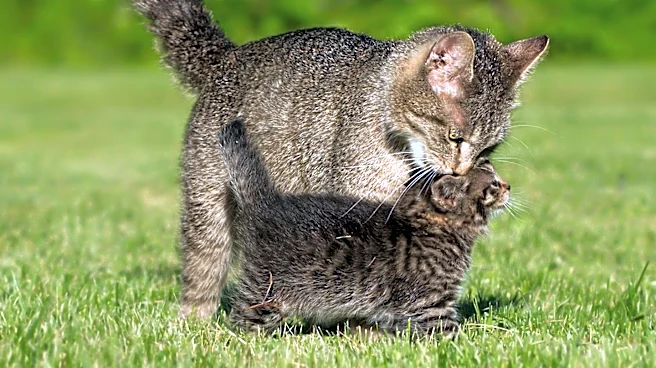
Kittenhood is a critical period for a cat's cognitive development, during which they acquire fundamental survival skills. These skills are primarily learned through observing their mothers and engaging in play with other cats. Play, far from being just a recreational activity, is essential for kittens. It helps them establish social order within their group, build crucial hunting skills, and generally exercise for the roles they will take on as adults. This observational learning is a cornerstone of their early intelligence, allowing them to absorb complex behaviors by watching and imitating.
This early learning phase sets the foundation for future cognitive growth. Kittens who observe their mothers performing specific tasks are often able to perform those same tasks sooner than kittens who observe unrelated adult cats or those who learn solely through trial and error. This demonstrates the significant impact of direct maternal observation on their learning capacities, underscoring the importance of early environmental influences on feline intelligence.
Domestication and Cognitive Evolution
The study of cat intelligence largely focuses on domesticated cats, whose cognitive development has been significantly influenced by their living conditions. Urban environments, in particular, have presented domesticated cats with unique challenges that necessitate adaptive behaviors, thereby contributing to their cognitive growth. This exposure to diverse stimuli and problem-solving scenarios in human-dominated settings has played a role in shaping their intelligence.
Furthermore, selective breeding and genetic changes over generations have also impacted the intelligence of domesticated cats. These factors have potentially enhanced certain cognitive traits that are beneficial for coexisting with humans. While kittens learn survival skills from their mothers, adult cats continue to refine their abilities through trial and error, constantly adapting to their surroundings and experiences. This ongoing refinement is a testament to their capacity for continuous learning throughout their lives.
Sensorimotor Intelligence and Object Permanence
In controlled experiments, cats have demonstrated a fully developed concept of object permanence, indicating that their sensorimotor intelligence is complete. This means cats understand that objects continue to exist even when they are out of sight. Their search behavior in tasks designed to test this concept is consistent with an ability to mentally represent an object that is not currently sensed, reflecting a sophisticated level of sensorimotor intelligence.
This aspect of feline cognition is particularly interesting when compared to human infants. While human infants are tested with multiple invisible displacements of an object to assess the emergence of mental representation during the sixth and final stage of sensorimotor intelligence, cats exhibit this understanding in a complete form. This suggests a robust cognitive framework for understanding their physical world, allowing them to navigate and interact with their environment effectively, even when objects are temporarily hidden from view.