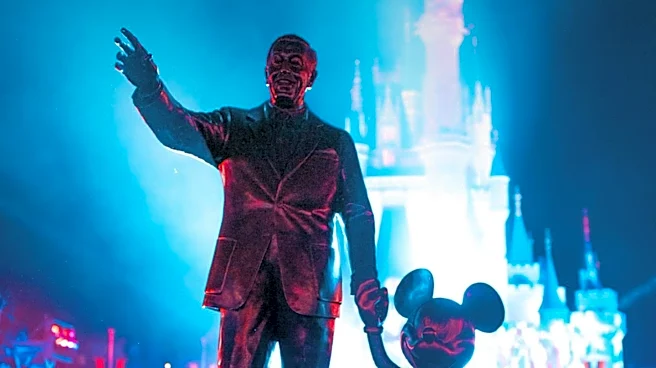






In 1959, Walt Disney Productions embarked on a search for a location to establish a second resort, intended to complement Disneyland in Anaheim, California, which had opened its gates in 1955. This initiative was driven by market research indicating that a mere 5% of Disneyland's visitors originated from east of the Mississippi River, despite 75% of the U.S. population residing in that region. Furthermore, Walt Disney harbored a strong desire for greater
control over a larger expanse of land for his next venture, having grown dissatisfied with the commercial developments that had emerged around Disneyland. This ambition laid the groundwork for what would become one of the world's most iconic entertainment destinations.
The Florida Project: A Secretive Land Acquisition
After dismissing the idea of an indoor theme park in St. Louis, Missouri, Walt Disney personally flew over a potential site in Orlando, Florida, in November 1963. This particular location stood out due to its well-developed road network, the planned construction of Interstate 4 and Florida's Turnpike, and the proximity of McCoy Air Force Base (now Orlando International Airport) to the east. Disney ultimately selected a centrally located site near Bay Lake, a decision that marked the true beginning of the project. Internally, this ambitious undertaking was referred to as "The Florida Project." Early planning documents underscored the significant economic impact the project was expected to have on Florida, even before construction commenced.
To prevent a surge in land speculation, Walt Disney Productions employed a strategy involving various dummy corporations to acquire a vast 27,443 acres (43 sq mi; 111 km2) of land, beginning in April 1964. These corporations were initially given whimsical names such as the "Ayefour Corporation," "Latin-American Development and Management Corporation," and the "Reedy Creek Ranch Corporation." These entities were eventually consolidated by Disney into the Compass East Corporation in 1966. Some of these original dummy corporation names are now commemorated on windows above Main Street, U.S.A. in the Magic Kingdom, serving as a subtle nod to the project's secretive origins.
Navigating Secrecy and Speculation
Operating under strict secrecy, real estate agents, who were unaware of their client's true identity, began making offers to landowners in parts of southwest Orange and northwest Osceola counties. They meticulously avoided revealing the full scope of their intentions. Through these covert negotiations, Disney's team secured numerous land contracts, including large tracts of land for as little as $100 an acre. At the time, many landowners were eager to divest themselves of their property, much of which consisted of swampy terrain. Additionally, Disney's representatives negotiated a deal with Tufts University to purchase the mineral rights to the land for $15,000. Recognizing that the recording of the first deeds would inevitably trigger intense public scrutiny, Disney strategically delayed the filing of paperwork until a substantial portion of the land was under contract, thus maintaining the project's confidentiality for as long as possible.
Once the initial deeds were recorded, rumors and speculation about the land purchases began to circulate. Early theories suggested possible development by NASA, given the proximity to the Kennedy Space Center, or involvement from other prominent investors like Ford, the Rockefellers, and Howard Hughes. However, an Orlando Sentinel news article published on May 20, 1965, acknowledged a popular rumor that Disney was constructing an "East Coast" version of Disneyland. The publication, however, initially dismissed its accuracy, citing an earlier interview with Disney at Kennedy Space Center where he claimed a $50 million investment was planned for Disneyland and expressed no interest in building a new park.
The Unveiling of a Dream
In October 1965, Emily Bavar, an editor from the Sentinel, visited Disneyland during its 10th-anniversary celebration. During an interview, she directly asked Walt Disney if he was behind the recent land acquisitions in Central Florida. Bavar later recounted that Disney "looked like I had thrown a bucket of water in his face" before he denied the story. His reaction, combined with other information gathered during her Anaheim visit, prompted Bavar to publish a story on October 21, 1965, predicting that Disney was indeed building a second theme park in Florida. Just three days later, after compiling more information from various sources, the Sentinel ran another article with the headline, "We Say: 'Mystery' Industry Is Disney," effectively breaking the news to the public.
Walt Disney had originally intended to publicly announce Disney World on November 15, 1965. However, in light of the Sentinel's revelations, Disney requested that Florida Governor Haydon Burns confirm the story on October 25. Governor Burns complied, hailing Disney's project as "the greatest attraction in the history of Florida." The official reveal proceeded as planned on November 15, with Walt Disney joining Governor Burns in Orlando. During this announcement, Disney provided general information about the project, careful not to disclose specific details, though he did state that the plan was to "top what we have, or at least be equivalent to what we have now, in California," setting high expectations for the new venture.