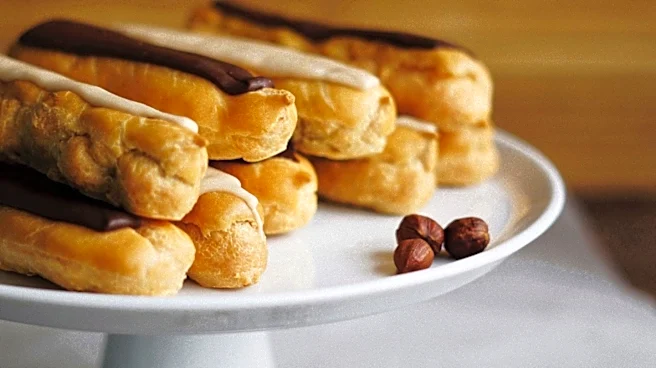





The eclair, a beloved French pastry, boasts a history as rich and delightful as its cream filling. Originating in the 19th century in Lyon, France, this oblong treat has evolved from its early names to become a globally recognized dessert. Its unique name, derived from the French word for 'flash of lightning,' hints at both its quick consumption and the glistening appearance of its frosting, adding a layer of intrigue to its culinary journey.
Early Origins and Naming
Before
it was widely known as an eclair, this pastry had different monikers in its birthplace of Lyon. Until around 1850, it was referred to as "pain à la Duchesse," meaning 'Duchess-style bread,' or "petite duchesse," which translates to 'little duchess.' These early names suggest a connection to nobility or a refined culinary tradition, indicating its esteemed status even in its nascent stages. The transition to the name "eclair" occurred sometime after this period, with the word first being attested in both English and French in the 1860s.
The etymology of "eclair" itself is a point of fascinating discussion. The French word "éclair" directly translates to 'flash of lightning.' One popular theory for this naming convention is that the pastry is eaten very quickly, almost in a flash. This speaks to its deliciousness and perhaps its manageable size, encouraging rapid enjoyment. Another compelling theory suggests that the name comes from the glistening quality of the frosting, which might resemble a flash of lightning. Both explanations offer a charming insight into how this pastry captured the imagination of those who first named it.
Composition and Evolution of Fillings
At its core, an eclair is crafted from choux dough, the same versatile dough used for profiteroles. This dough is typically piped into an oblong shape using a pastry bag and then baked until it achieves a crisp, hollow interior. This hollow structure is crucial, as it provides the perfect cavity for the rich fillings that define the eclair.
Traditionally, eclairs are filled with custard, known in French as *crème pâtissière*, whipped cream, or chiboust cream. However, the culinary world has seen an expansion of these classic fillings. Modern variations include pistachio- and rum-flavored custards, a variety of fruit-flavored fillings, and even chestnut purée. This adaptability in fillings demonstrates the eclair's capacity for innovation while retaining its fundamental structure.
Icing and Regional Variations
Once filled, the eclair is typically topped with a flavored icing, most commonly fondant icing. This sweet, smooth topping not only adds another layer of flavor but also contributes to the pastry's appealing visual presentation. In instances where the icing is caramel, the dessert may be given a different name: "bâton de Jacob," which literally means 'Jacob's staff.' This alternative name highlights how specific variations can lead to distinct identities within the broader eclair family.
Beyond France, the eclair has inspired similar pastries. For example, a pastry that shares many characteristics with the eclair but is round rather than oblong is known as a religieuse. In the United States, Dunkin' Donuts markets Long John donuts as eclairs, indicating a localized interpretation or adaptation of the concept. The enduring popularity of this pastry is further underscored by the celebration of National Eclair Day in the U.S. on June 22, a testament to its widespread appeal and cultural integration.