





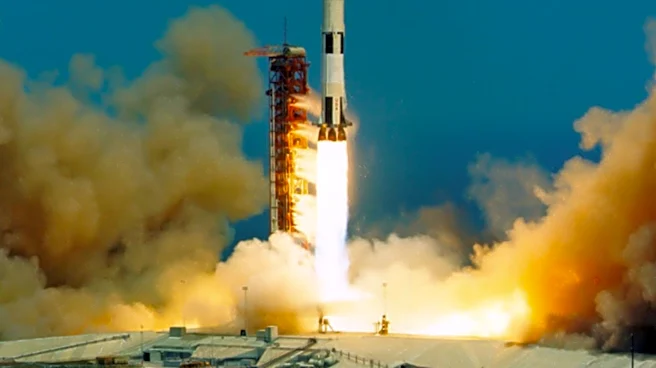

Launched in 1967, the Applications Technology Satellite 3, or ATS-3, embarked on a mission that would far exceed its initial expectations, serving as a vital experimental geostationary weather and communications satellite for NASA until 2001. This remarkable lifespan of 34 years made it, for a time, the oldest satellite still in operation, a testament to its robust design and the dedication of its operators. From its launch on November 5, 1967, from
Cape Canaveral, ATS-3 quickly established itself as a pivotal asset, not only capturing NASA's first color photo of the full-disk Earth but also providing critical communication links and weather data for decades.
A Pioneer in Global Communication
ATS-3 was designed with a primary focus on advancing communication technologies. It carried out experiments in both VHF and C-band communications, pushing the boundaries of satellite-based data transmission. Its mechanically despun antenna was a key component in maintaining stable communication links. The satellite's communication capabilities were so reliable that it provided essential links to remote areas, including Antarctica and the Pacific Basin, demonstrating its global reach and utility. This made it an invaluable tool for various scientific and operational endeavors that required consistent long-distance communication.
Beyond its experimental role, ATS-3 transitioned into a practical communications workhorse, especially during times of crisis. Its ability to maintain connectivity when terrestrial systems failed proved crucial. For instance, during the 1985 Mexico City earthquake, ATS-3 served as a vital communication link for rescue operations, enabling coordination and information flow when it was most needed. Similarly, in the aftermath of the 1980 eruption of Mount St. Helens, the satellite played a significant role in supporting communication efforts, highlighting its reliability in emergency situations.
Revolutionizing Weather Monitoring
One of ATS-3's most impactful contributions was in the field of meteorology. Equipped with a color spin-scan camera, principally developed by Verner E. Suomi, the satellite provided unprecedented views of Earth's weather systems. Its capture of NASA's first color photo of the full-disk Earth on November 10, 1967, was not just a photographic milestone but also a demonstration of its potential for comprehensive weather observation. This image, a digital mosaic, offered a new perspective on global atmospheric conditions.
Around 1970, ATS-3 became a dedicated tool for collecting images of weather patterns, with a particular emphasis on tracking developing hurricanes in the Western Hemisphere. It regularly downlinked 1,200-line photos approximately every 25 minutes during daylight hours to NOAA's Command and Data Acquisition Station at Wallops Station, Virginia. These detailed images were then transferred to various users, providing meteorologists with crucial, near real-time data for forecasting and storm tracking. This continuous stream of visual data significantly enhanced the understanding and prediction of severe weather events.
Sustaining Operations for Decades
The longevity of ATS-3's mission is a remarkable aspect of its history. Operating for 34 years, it outlasted many of its contemporaries and continued to provide valuable services well into the 21st century. This extended operational life was partly due to technological advancements, such as its hydrazine propulsion system, which was incorporated after hydrogen peroxide system failures on ATS-1. The success of the hydrazine system on ATS-3 led to its adoption as the sole propulsion system on subsequent satellites like ATS-4 and ATS-5.
Despite its age, ATS-3 faced operational challenges, such as its spinning beam antennas occasionally locking up and rotating with the satellite. When this occurred, powerful ground-based transmitters, like the one at Mojave, were required to send digital instructions to re-aim the antenna back at Earth. The fact that operators could overcome such issues and keep the satellite functional for so long underscores the dedication and ingenuity involved in its long-term management. Its eventual deactivation in 2001 marked the end of an era for a satellite that truly defined endurance and versatility in space.