

The Buenos Aires Grand Prix stands as a pivotal event in the annals of Argentine motor racing, tracing its origins back to 1930. Initially conceived as a Formula Libre event, this race has witnessed numerous transformations in its circuits and regulations, reflecting the dynamic evolution of motorsport in Argentina. From its early days on the Costanera circuit to its later iterations at purpose-built facilities, the Grand Prix consistently attracted
both local heroes and international racing legends, solidifying its place as a cornerstone of the country's sporting heritage. Its history is intertwined with political shifts and the rise of iconic drivers, making it a compelling narrative of speed, passion, and national pride.
Early Beginnings and the Temporada Series
The Buenos Aires Grand Prix first roared to life in 1930, taking place on the Costanera circuit. This initial phase continued until 1940, after which the event briefly moved to the Retiro circuit in 1941. Following a six-year hiatus, racing activities resumed in 1947, coinciding with General Juan Peron's time in office. This revival marked the inception of the South American "Temporada" Grand Prix series, which saw races contested twice a year under Formula Libre regulations. The 1947 Temporada events were notably dominated by Italian driver Luigi Villoresi, who secured victories in all races.
During this period, the Grand Prix became a magnet for talent, drawing in drivers from Brazil and Europe, alongside emerging Argentine stars. Among these were Juan Manuel Fangio and José Froilán González, who would later achieve international acclaim by competing regularly in Europe. The race's venue shifted again in 1948, moving to the Palermo circuit, where it hosted six of the twelve "Peron Cup" races until the close of 1950. The Costanera Norte circuit then briefly hosted its final three Grand Prix events in 1951, just before the completion of a significant new development in Argentine motorsport.
The Autodromo 17 de Octubre Era
The year 1951 marked a turning point with the completion of the Autodromo 17 de Octubre, a purpose-built circuit designed to host major Grand Prix series. This state-of-the-art facility became the primary venue for various editions of the Buenos Aires Grand Prix from 1952 until 2009. An exception was the 1956 event, which was held at the General San Martin circuit in Mendoza. The Autodromo 17 de Octubre, constructed in 1952 on swampland just outside Buenos Aires, was inaugurated in March 1952 with the fifth edition of the "Perón Cup," won by Juan Manuel Fangio. In 1953, it proudly hosted the first Formula One race ever held in South America, cementing its status as a premier racing destination.
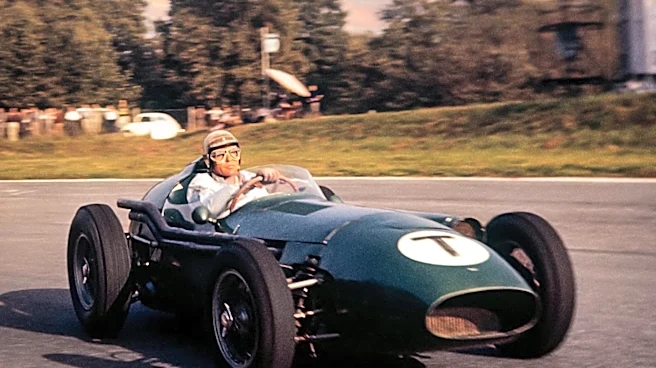
The circuit offered four distinct configurations for Grand Prix racing, each presenting unique challenges. From 1953 to 1960, the Argentine Grand Prix utilized the "No. 2" layout, run clockwise in all years except 1954, when it was run counterclockwise. The 1953 race, while a victory for Alberto Ascari, was marred by a tragic accident due to overcrowding, highlighting the immense public interest in the event. The following year, Fangio secured his first home Grand Prix victory, going on to win three consecutive Argentine Grands Prix, including the grueling 1955 race, which was one of the hottest on record with track temperatures reaching 122°F (51°C). Fangio, driving for Mercedes, was the only driver to complete all 96 laps without relief, enduring severe burns to his leg.
Fluctuations and Modern Revival Attempts
After Fangio's retirement and the departure of José Froilán González from racing, coupled with political instability following Peron's exile in 1955, the Argentine Grand Prix vanished from the Formula One calendar after 1960 for over a decade. It made a return in 1971 with a non-championship Formula One race, won by Chris Amon. The Grand Prix officially rejoined the World Championship in 1972, introducing Carlos Reutemann as a new local favorite. Reutemann famously took pole position in his world championship debut, a rare feat, though Jackie Stewart won the race. The circuit configuration for these years, "No. 9," was similar to the earlier "No. 2" but with a shortened section after Tobogan and a tighter Horquilla turn.
From 1974 to 1981, the faster and longer "No. 15" configuration was employed, featuring two very fast corners, long straights, and the spectacular Curvon Salotto. This layout provided ample overtaking opportunities, particularly around the lake section. The 1980 race was nearly boycotted by drivers due to the poor track surface, which was breaking up in the heat. Despite repairs, the issue persisted, leading to a chaotic race won by Alan Jones. The 1981 race saw Nelson Piquet take victory, but the 1982 event was canceled due to political fallout and the Falklands War, leading to the termination of Argentina's contract with the largely European sport. An attempt to revive the race in 1986 failed.
In 1991, a private consortium purchased and began upgrading the Buenos Aires track, securing a spot on the 1994 F1 calendar. However, the race was aborted for further modernization. The general layout remained, but an "S" chicane named after Ayrton Senna was added. The "No. 6" arena circuit, a tight and twisty configuration that excluded the lake run, was used for the modernized Grand Prix from 1995 to 1998. This layout, however, drew criticism from Formula One drivers for its difficulty in overtaking. Damon Hill won in 1995 and 1996, and Jacques Villeneuve in 1997. Financial difficulties ultimately led to the 1998 race, won by Michael Schumacher, being the last running of the Argentine Grand Prix. In 2023, the name was revived for the Argentine stock car racing championship Turismo Carretera, signaling a new chapter for the historic name.