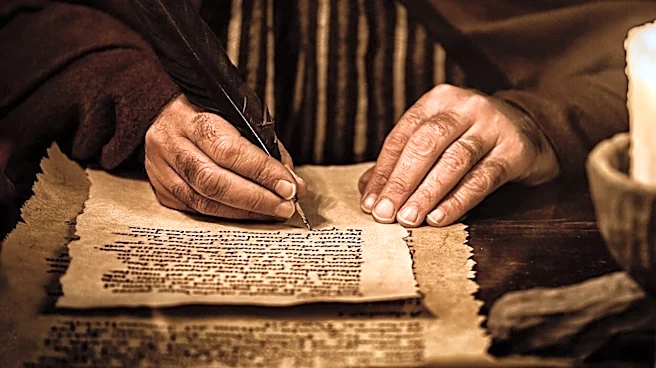








In the Middle Ages, the scriptorium served as a vital hub within monastic complexes, dedicated primarily to the copying of manuscripts. This term, derived from the Latin verb *scribere* meaning "to write," with the suffix *orium* indicating a place, refers to both the physical writing room and, by extension, any location where scribes performed their copying activities. These monastic writing centers were not merely workshops; they were crucial for safeguarding
Greek and Latin culture and functioned as significant centers for intellectual thought and cultural development. Often connected to the monastery's library, the scriptorium played an indispensable role in the preservation and dissemination of knowledge during a period when books were painstakingly created by hand.
The Physical Space and Its Inhabitants
A typical scriptorium was a large hall designed to be well-lit, often utilizing numerous windows to maximize natural light. Monks would position themselves near these light sources, as artificial light was generally prohibited due to concerns about potential damage to the precious manuscripts. Within this dedicated space, a diverse group of individuals collaborated to produce books. This team included calligraphers, who specialized in creating valuable books, and copyists, who handled basic production and correspondence. Correctors were responsible for assembling the written sheets and comparing the finished work against the original manuscript. Illuminators painted illustrations, sometimes incorporating small gold leaf pieces, while rubricators painted letters in red. Alluminators specifically focused on placing gold leaf, and finally, binders were tasked with assembling and binding the completed codex or manuscript.
Up to 15 copyists could work together in a scriptorium, with some capable of copying as many as thirty sheets per day. The tools of their trade included pens, ink, penknives, rulers, awls (used to make tiny holes for guiding straight lines), and lecterns. Miniature work required its own specialized tools and materials. All necessary supplies were provided by the *armarius*, the monastery's librarian, who effectively directed the entire copying operation and often held other responsibilities within the monastery. In some instances, as many as thirty scribes could work simultaneously in the same room.
The Craft of Manuscript Creation
The process of manuscript creation was comprehensive, encompassing all stages of book production. After the Islamic conquest of Egypt in the mid-7th century, papyrus became largely unavailable and expensive, leading to parchment becoming the primary writing material until the 13th century. Parchment sheets were prepared from the treated skins of domestic animals like cows, sheep, and goats. The highest quality parchment, known as vellum, was derived from calfskin. The various steps involved in preparing parchment for writing—cutting sheets, perforating, ruling, and smoothing—were well-documented and understood.
Once a sheet of parchment was placed on a lectern, the scribe's first task was to draw horizontal lines, typically 26, to ensure straight writing. They also defined spaces to be left open for miniatures. The scribe would then copy the text onto the ruled page. This work was not limited to reproducing ancient texts, Bibles, or commentaries on sacred scriptures; often, original works were also composed within the scriptorium. Interestingly, scriptoria sometimes developed unique graphic styles, such as the distinctive 'a' and 'b' letters characteristic of the Corbie scriptorium or the 'a' and 'z' letters from Laon, which were variations of what paleographers call Merovingian script.
The Evolution and Decline of Monastic Scriptoria
Miniaturists and painters often worked separately from the scribes. The illumination process typically occurred after the text was written but before the book was bound, often in different rooms and sometimes months later. Monastic scriptoria produced books for internal monastic use, for exchange with other institutions, and for the limited number of literate laypeople. These centers were crucial for maintaining a supply of liturgical texts for the monasteries themselves for many centuries.
However, by the mid-13th century, monastic scriptoria faced significant competition from lay workshops. These secular establishments offered a broader range of literature, moving beyond purely edifying or prayer-related texts, and increasingly produced works in vernacular languages rather than solely Latin. Lay workshops also developed more efficient copying methods, such as the *pecia* system used in universities. While a monk copied works as a religious duty, a lay scribe copied for profit, reflecting a fundamental difference in motivation. Despite this growing competition, monastic scriptoria remained central to the production of liturgical texts for monasteries until the widespread adoption of printing technology eventually transformed book production.