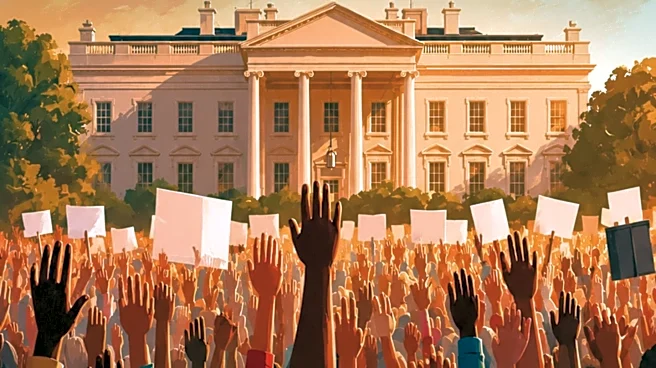


The Moratorium to End the War in Vietnam, a series of massive demonstrations in October and November 1969, presented a significant challenge to President Richard Nixon's administration. While the anti-war movement gained considerable momentum and public visibility, Nixon's response was a calculated effort to maintain control of the narrative and solidify support for his Vietnam War policies. His reactions, both public and private, reveal a president
determined not to be swayed by street protests, culminating in his famous "silent majority speech" that sought to rally a different segment of the American populace.
Initial Dismissal and Private Outrage
On October 15, 1969, the day of the first nationwide Moratorium, the White House press secretary publicly declared that President Nixon was "completely indifferent" to the protests and that it had been "business as usual." Nixon himself issued a statement asserting, "Under no circumstances will I be affected" by demonstrations, adding that "policy made in the streets equals anarchy." This public stance aimed to project an image of presidential resolve and an unwillingness to capitulate to public pressure.However, behind closed doors, Nixon's reaction was far from indifferent. He was reportedly enraged by the Moratorium, feeling "very much besieged" and believing that the protests had "undercut his policy of winning 'peace with honor' in Vietnam." This private fury prompted him to instruct his aides to begin drafting a speech specifically designed to rebut the Moratorium protests. The process of crafting a satisfactory response took two weeks, indicating the seriousness with which the administration viewed the challenge posed by the anti-war movement.
Vice President Agnew's Provocative Rhetoric
As part of the administration's counter-offensive, Vice President Spiro Agnew delivered a series of sharp criticisms against the anti-war movement and its perceived allies. On October 19, 1969, in a speech in New Orleans, Agnew charged that "a spirit of national masochism prevails, encouraged by an effete corps of impudent snobs who characterize themselves as intellectuals." He further accused the peace movement of being controlled by "hardcore dissidents and professional anarchists" who were allegedly planning "wilder, more violent" demonstrations for the upcoming Moratorium.Agnew continued his attacks on November 13 in Des Moines, specifically targeting the media. He declared that the Moratorium was "all the work of the media" which he described as "a small and unelected elite that do not—I repeat do not—represent the view of America." Agnew accused the media of being biased against Nixon and in favor of the peace movement, claiming they "to a man" represented "the geographic and intellectual confines of New York and Washington," singling out *The New York Times* and *The Washington Post* for particular criticism. This rhetoric was intentionally provocative and polarizing, designed to rally support among those who felt alienated by the media and the anti-war movement.
The "Silent Majority" Speech and Its Aftermath
In direct response to the October 15 Moratorium, President Nixon delivered his "silent majority speech" on national television on the evening of November 3, 1969. In this address, Nixon appealed for the support of the "silent majority" of Americans for his Vietnam War policy. While professing to share the protesters' goal of peace, he argued that the United States needed to win in Vietnam, which required continuing the war until North Vietnam ceased its efforts to overthrow South Vietnam. Nixon framed the conflict not as a matter of South Vietnam's importance, but as a test of U.S. credibility with its allies.Nixon promised that his policy of Vietnamization would gradually reduce American casualties and stated his willingness to compromise if North Vietnam recognized South Vietnam. He also warned of "strong and effective measures" if the war persisted. The speech concluded with a powerful appeal for unity: "And so tonight, to you, the great silent majority of my fellow Americans—I ask for your support. Let us be united for peace. Let us be united against defeat. Because let us understand: North Vietnam cannot defeat or humiliate the United States. Only Americans can do that." The public response to Nixon's speech was overwhelmingly positive, with White House phone lines jammed by congratulatory calls, and his public approval ratings soared. This emboldened Nixon, who reportedly told his aides, "We've got those liberal bastards on the run now, and we're going to keep them on the run."