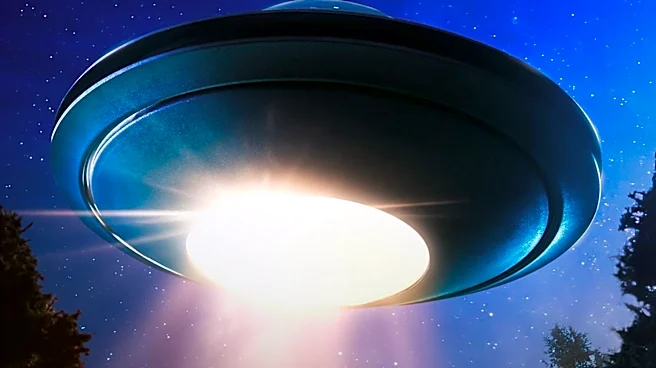










The name "Foo Fighters," famously adopted by the American rock band, has a fascinating and mysterious origin rooted in the skies of World War II. It refers to unidentified flying objects or mysterious aerial phenomena that were widely reported by Allied pilots over both the European and Pacific theaters of operations during the 1940s. These sightings were not isolated incidents but a widespread phenomenon that puzzled military intelligence and captivated
the imaginations of those who witnessed them. The term itself, born from the slang of wartime aviators, encapsulates the bewilderment and intrigue surrounding these unexplained aerial encounters.
Wartime Sightings and Pilot Accounts
Reports of "foo fighters" began formally in November 1944, and quickly became a common occurrence. Witnesses, primarily Allied aircrews, initially presumed these mysterious objects to be secret weapons employed by the enemy, either German or Japanese forces. However, subsequent investigations revealed that neither side had any knowledge of such technology. Pilots described these phenomena in various ways: as fiery, glowing red, white, or orange lights. Some accounts likened them to "Christmas-tree lights" that seemed to playfully interact with their aircraft, making wild turns before simply vanishing. A consistent detail in many reports was that these objects flew in formation with the aircraft and appeared to be under intelligent control. Crucially, they never displayed hostile behavior, yet they could not be outmaneuvered or shot down, adding to their enigmatic nature. The widespread nature of these sightings led to them earning a name; in the European Theater, they were sometimes called "Kraut fireballs," but the more prevalent term became "foo fighters."
The Curious Etymology of "Foo"
The term "foo fighters" itself has an interesting etymology, tracing back to popular culture of the early 1930s. The nonsense word "foo" was first popularized by cartoonist Bill Holman, who frequently peppered his *Smokey Stover* fireman cartoon strips with "foo" signs and puns. It was a radar operator in the U.S. 415th Night Fighter Squadron, Donald J. Meiers, who is credited with giving the aerial phenomena their name. Meiers, an avid reader of Holman's strip from Chicago, was familiar with *Smokey Stover*'s catch-phrase: "where there's foo, there's fire." During a mission debriefing on November 27, 1944, after he and Pilot Lt. Ed Schleuter sighted a red ball of fire, an agitated Meiers reportedly pulled out a copy of the comic strip and exclaimed, "[I]t was another one of those fuckin' foo fighters!" According to Frederic "Fritz" Ringwald, the unit's S-2 Intelligence Officer, the term stuck due to the lack of a better name. When an Associated Press correspondent, Bob Wilson, investigated the story in December 1944, the term was "cleaned up" to simply "foo fighters" for public consumption, a sanitization also adopted by the squadron commander, Capt. Harold Augsperger, for historical records. Other theories suggest the term might be a corruption of the French word *feu* for fire, or even the military acronym FUBAR.
Attempts at Explanation and Lingering Mystery
The military took the "foo fighter" sightings seriously, initially suspecting them to be advanced enemy weaponry. However, as investigations progressed, no such programs were found among German or Japanese forces. The 415th Night-Fighter Squadron's Intelligence Officer, Captain Ringwald, compiled reports that were escalated to the highest echelons, including Supreme Headquarters Allied Expeditionary Force (SHAEF), but no answers were forthcoming. In March 1945, the British Air Ministry offered a tentative explanation, suggesting some might have been Me 262 aircraft or flak rockets, but ultimately concluded, "The whole affair is still something of a mystery and the evidence is very sketchy and varied so that no definite and satisfactory explanation can yet be given." Post-war interrogations of German scientists and Luftwaffe officers yielded no knowledge of a secret weapons program that could account for the sightings. Alternative explanations have been proposed, such as electrical discharges from aircraft wings, similar to St. Elmo's Fire, or a resemblance to ball lightning. The U.S. Navy even initiated Project X-148-AV-4-3 in April 1945 to study visual illusions and aviators' vertigo, recognizing that pilots often lacked sufficient information about disorientation phenomena, leading to "inexplicable events" and a sense of "mystery." Despite these efforts, the true nature of the "foo fighters" largely remains an unsolved historical enigma, a testament to the unexplained phenomena encountered during wartime.