





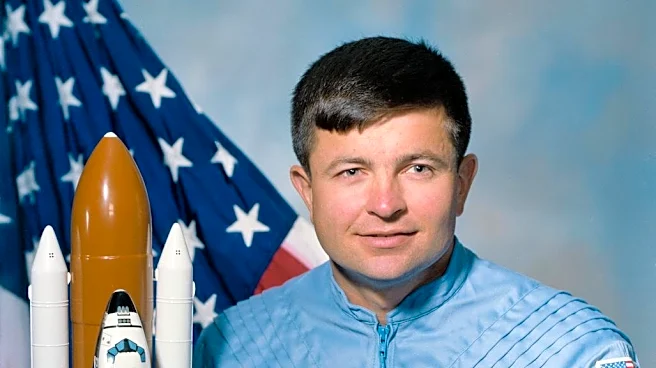

The STS-41-G mission, launched on October 5, 1984, aboard the Space Shuttle Challenger, marked a significant milestone in human space exploration, particularly for women. Among its many achievements, the mission is perhaps best remembered for Kathryn D. Sullivan's groundbreaking extravehicular activity (EVA). On October 11, 1984, Sullivan became the first American woman to walk in space, a moment that not only highlighted her individual accomplishment
but also symbolized a broader shift towards greater inclusion and capability for women in the astronaut corps. Her spacewalk, performed alongside David C. Leestma, demonstrated crucial in-orbit capabilities and paved the way for future space endeavors.
A Pioneering Crew and Dual Female Presence
The STS-41-G mission was notable for its crew composition even before Sullivan's historic spacewalk. It was the first shuttle mission to carry a crew of seven, the largest number of individuals to fly on a single spacecraft at that time. This diverse crew included commander Robert L. Crippen, pilot Jon A. McBride, and mission specialists David C. Leestma, Sally K. Ride, and Kathryn D. Sullivan. Significantly, it was also the first time two female astronauts, Sally K. Ride and Kathryn D. Sullivan, had flown together on a single mission. This dual presence underscored a growing recognition of women's capabilities and contributions to spaceflight, moving beyond the initial barrier-breaking flights to a more integrated role within the astronaut program.
Beyond the American contingent, the crew also featured international specialists, including Paul D. Scully-Power, the first Australian-born person in space, and Marc Garneau, the first Canadian astronaut. This blend of diverse backgrounds and expertise set the stage for a mission rich in scientific and operational achievements, with Sullivan's EVA standing out as a particularly iconic moment.
The First American Woman in Space: The EVA Details
Kathryn D. Sullivan's historic spacewalk took place on October 11, 1984, six days into the STS-41-G mission. Alongside fellow mission specialist David C. Leestma, she performed a 3-hour extravehicular activity. The primary objective of this EVA was to demonstrate the Orbital Refueling System (ORS). This demonstration was crucial for proving the feasibility of refueling satellites while they were in orbit, a capability that could significantly extend the operational lifespan of valuable spacecraft and reduce the need for costly and complex replacement missions. Sullivan's successful participation in this demonstration not only showcased her technical proficiency but also solidified her place in history as the first American woman to perform a spacewalk.
The images of Sullivan working outside the Challenger became powerful symbols of progress in space exploration. Her achievement built upon the foundation laid by earlier female astronauts and opened new doors for women to participate in the most challenging aspects of spaceflight. The success of the ORS demonstration also had practical implications, highlighting NASA's commitment to developing technologies that would enhance the longevity and efficiency of its space assets.
Broader Mission Context and Lasting Impact
While Sullivan's EVA was a central highlight, the STS-41-G mission encompassed a wide array of scientific and operational goals. The mission deployed the Earth Radiation Budget Satellite (ERBS), which was designed to measure solar energy and its reradiation into space, and studied the seasonal movement of energy. It also operated the Shuttle Imaging Radar-B (SIR-B) as part of the OSTA-3 experiment package, which included cameras for Earth photography and air pollution measurement. Payload specialists Scully-Power and Garneau conducted their own series of oceanography and Canadian-sponsored experiments, respectively.
The mission's duration of over eight days, covering more than 5 million kilometers and 133 orbits, underscored the extensive work performed by the crew. The successful landing at Kennedy Space Center marked another achievement for the Challenger. Kathryn D. Sullivan's pioneering spacewalk remains a powerful testament to the breaking of barriers in space, inspiring future generations and demonstrating the critical role women play in advancing human exploration beyond Earth.