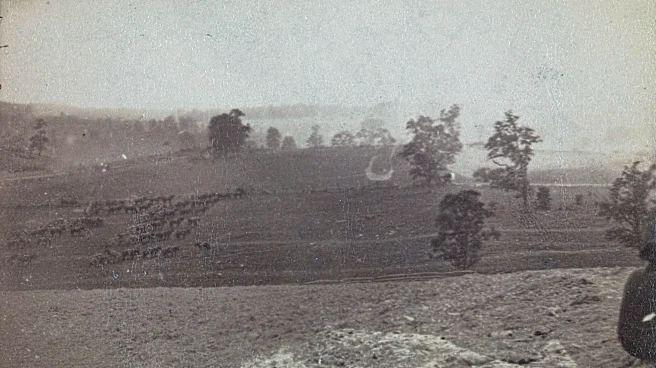





Sherman's March to the Sea, officially known as the Savannah campaign, was a pivotal military operation during the American Civil War. Conducted by United States Army Major General William T. Sherman from November 15 to December 21, 1864, this campaign cut a swath of destruction through Georgia. Beginning with Sherman's troops departing Atlanta, a city recently captured by Union forces, the march concluded with the seizure of the vital port of Savannah.
This campaign was not merely a movement of troops but a deliberate strategy of "hard war," designed to cripple the Confederacy's ability and will to fight by targeting not only military assets but also civilian infrastructure and resources.
The Strategy of "Living Off the Land"
The Savannah campaign was conceived by Generals Ulysses S. Grant and William T. Sherman with a novel approach to military logistics. It drew inspiration from Grant's successful Vicksburg campaign and Sherman's Meridian campaign, both of which demonstrated the effectiveness of armies operating with reduced reliance on traditional supply lines. The core idea was for Sherman's forces to "live off the land" after consuming their initial 20 days of rations. This meant that instead of depending on lengthy and vulnerable supply chains, the army would forage for its needs directly from the local environment.
Foragers, colloquially known as "bummers," were tasked with acquiring food from local farms to sustain the army. This practice was integral to the campaign's design, allowing Sherman's large force to move rapidly without being tethered to a fixed supply route. Simultaneously, these forces were engaged in systematic destruction of Georgia's infrastructure. Railroads were torn up, manufacturing facilities were dismantled, and agricultural resources were destroyed. Sherman even utilized livestock and crop production data from the 1860 United States census to plan his route through areas where foraging would be most effective, ensuring his troops could sustain themselves while maximizing the economic damage to the Confederacy.
Scorched Earth Tactics and Economic Disruption
Emulating the medieval European military tactic of chevauchée, Sherman's forces implemented a "scorched earth" policy throughout their march. This policy involved the widespread destruction of anything that could aid the Confederate war effort. Military targets were, of course, primary objectives, but the scope of destruction extended far beyond. Industry, infrastructure, and civilian property were systematically targeted. This included twisting and breaking railroad rails, which were heated over fires and then wrapped around tree trunks, rendering them unusable. This method of destruction aimed to severely disrupt the Confederacy's economy and transportation networks, making it difficult to move troops and supplies.
The economic impact of the March to the Sea was immense. Sherman himself estimated that the campaign inflicted $100 million in destruction, a significant portion of which was considered "simple waste and destruction." The army wrecked approximately 300 miles of railroad, numerous bridges, and miles of telegraph lines. They seized vast quantities of livestock, including 5,000 horses, 4,000 mules, and 13,000 head of cattle. Additionally, 9.5 million pounds of corn and 10.5 million pounds of fodder were confiscated, and countless cotton gins and mills were destroyed. Military historians have noted that this extensive damage to railroads and Southern logistics effectively "knocked the Confederate war effort to pieces."
An Early Example of Total War
Sherman's March to the Sea was a bold and unconventional military operation for its era. His decision to operate deep within enemy territory without traditional supply lines was highly unusual. This campaign of "hard war" is considered by some historians to be an early example of total war in modern warfare. Total war blurs the lines between combatants and civilians, aiming to undermine an enemy's capacity and will to fight by targeting its economic and social foundations, not just its armies.
The operation significantly debilitated the Confederacy and contributed to its eventual demise. David J. Eicher noted that Sherman "had accomplished an amazing task," defying military principles by operating without supply or communication lines and destroying much of the South's potential and psychological will to wage war. The long-term economic impact was also substantial; a 2022 study indicated that the capital destruction caused by the March led to a significant contraction in agricultural investment, farming asset prices, and manufacturing activity, with elements of the agricultural decline persisting through 1920. Following this devastating campaign, Sherman's army continued its destructive path northward into the Carolinas, further cementing the legacy of his "hard war" strategy.
Aftermath and Lingering Controversies
Upon capturing Savannah, Sherman famously telegraphed President Lincoln, offering the city as a "Christmas gift." Lincoln's reply acknowledged the success and the honor due to Sherman, recognizing the strategic brilliance of dividing the Union army to achieve such a significant victory. However, the campaign's methods generated lasting controversy. Sherman's scorched earth policies have made his memory reviled by many Southerners, who view him as a destroyer.
The impact on enslaved people was complex. While some welcomed Sherman as a liberator and followed his armies, others reportedly felt betrayed by the Union army's ransacking, suffering alongside their owners. An estimated 10,000 liberated slaves followed Sherman's army, with hundreds perishing from hunger, disease, or exposure. Sherman did attempt to address the influx of refugees in Savannah, organizing relief efforts and arranging for captured rice to be sold to feed the city. Despite the immediate military success and strategic impact, the March to the Sea remains a deeply divisive event in American history, embodying the brutal realities of total war and its profound consequences for both combatants and civilians.