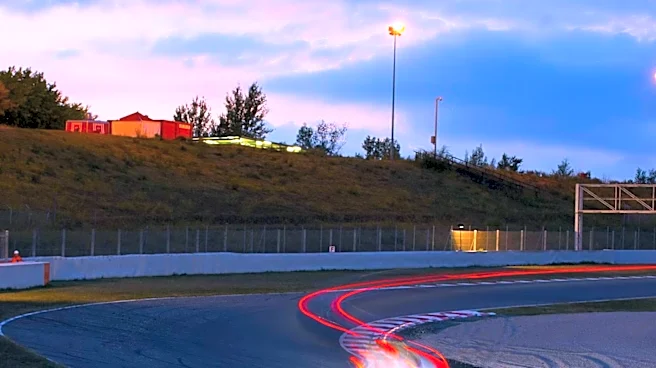





Laguna Seca Raceway, located near Salinas and Monterey, California, is a renowned road racing track with a rich history dating back to 1957. Originally built to replace the dangerous Pebble Beach Road Races, Laguna Seca has undergone numerous transformations to become the iconic venue it is today. This article delves into the historical development of Laguna Seca Raceway, highlighting key changes and milestones that have shaped its evolution.
The Early Years
Laguna
Seca Raceway was constructed in 1957 on part of the U.S. Army's Fort Ord, a maneuver area and field artillery target range. The track was built with funds raised from local businesses and individuals, costing $1.5 million. The lead designer, Wallace Holm, envisioned a grand design, but the final product was a collaborative effort shaped by committee decisions. The first race at Laguna Seca was held on November 9, 1957, with Pete Lovely winning in a Ferrari.
In its early years, Laguna Seca hosted a variety of racing events, including USRRC, Can-Am, Trans-Am, and Formula 5000. The track quickly gained popularity, attracting top drivers and becoming a staple in the racing community. However, the track's configuration and safety standards required continuous updates to meet evolving requirements.
Transformations and Upgrades
Over the decades, Laguna Seca underwent significant changes to enhance safety and accommodate different racing formats. In 1988, the track was extended from its original 1.9-mile length to meet the minimum-track-length criteria for MotoGP events. This extension included the addition of turns 3, 4, and 5, eliminating the straight that started at turn 2 and ended at turn 5.
Further modifications included the relocation of pedestrian bridges, expansion of gravel pits for additional runoff, and flattening the 'hump' at the top of the Rahal Straight in 2006. These changes were made to accommodate MotoGP riders, although some claimed it increased wind effects on race motorcycles. Despite these challenges, Laguna Seca continued to host prestigious events, including the American Le Mans Series and MotoGP races.
Recent Developments
In recent years, Laguna Seca has continued to evolve, with management and promotion of major racing events now handled by A&D Narigi Consulting, LLC. The track's primary corporate sponsor, WeatherTech, began its sponsorship in April 2018, leading to the official name change to WeatherTech Raceway Laguna Seca.
The track remains a vital part of the Monterey County Parks Department, contributing significantly to the local economy. A 2015 study by California State University, Monterey Bay, reported that the raceway generated $62.1 million to the Monterey County economy and $5.2 million in state and local taxes. As Laguna Seca continues to host a variety of events, its legacy as a premier racing venue endures.