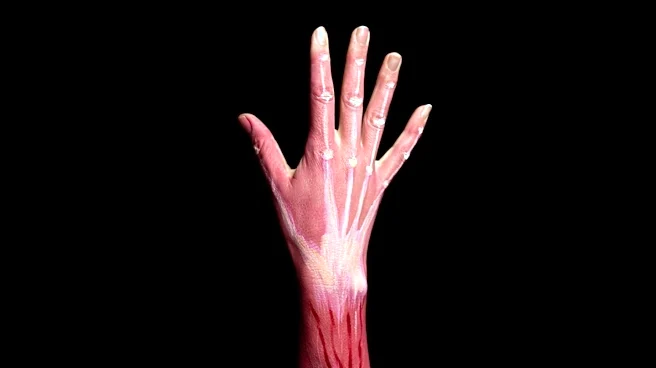










The palmaris longus is a fascinating muscle in the human forearm, often drawing attention due to its variable presence among individuals. Visible as a small tendon in the anterior wrist, positioned between the flexor carpi radialis and the flexor carpi ulnaris, it is not universally found in all people. Despite its occasional absence, the palmaris longus plays a role in wrist movement and is part of a larger group of muscles in the forearm. Its unique
characteristics make it a subject of interest in anatomy and clinical practice.
Anatomical Structure and Origin
The palmaris longus is described as a slender, elongated, and spindle-shaped muscle. It is typically widest in its middle section and tapers at its proximal and distal attachments. This muscle is situated on the medial side of the flexor carpi radialis, contributing to the overall structure of the forearm's flexor compartment. Its primary origin point is the medial epicondyle of the humerus, which it connects to via the common flexor tendon. This common flexor tendon is a crucial anatomical landmark, serving as the origin for several muscles in the forearm.
Beyond its main origin, the palmaris longus also draws fibers from the adjacent intermuscular septa and the antebrachial fascia. These additional points of origin help to anchor the muscle within the forearm. The muscle then transitions into a slender, flattened tendon. This tendon is notable for passing over the upper part of the flexor retinaculum, a strong fibrous band in the wrist, before inserting onto the central part of the flexor retinaculum itself and the lower part of the palmar aponeurosis. The palmar aponeurosis is a tough, fibrous sheet in the palm of the hand, and the palmaris longus's connection to it highlights its role in hand and wrist mechanics. Interestingly, the tendon frequently sends a tendinous slip to the short muscles of the thumb, further illustrating its intricate connections within the hand.
Function and Nerve Supply
The primary action of the palmaris longus is as a wrist flexor. This means it contributes to the bending movement of the wrist, bringing the hand closer to the forearm. While it is one of the five muscles that form the "flexor-pronator mass" in the forearm, its individual contribution to grip strength is not considered essential. This is evidenced by the fact that its absence does not negatively impact a person's ability to grip objects effectively. This functional redundancy is a key reason why its absence is often asymptomatic.
Regarding its nerve supply, the palmaris longus is innervated by the median nerve. The median nerve is a major nerve in the upper limb, responsible for motor and sensory functions in the forearm and hand. This innervation pathway ensures that the palmaris longus receives the necessary signals for contraction and proper function when present. The consistent innervation by the median nerve, regardless of the muscle's presence, underscores the organized neurological architecture of the human arm.
Absence and Observation
One of the most distinctive features of the palmaris longus is its variable presence. Reviews indicate that the rate of absence in the general population ranges from 10% to 20%. However, this rate is not uniform across all groups and can vary significantly among different ethnic populations. The absence of this muscle is generally considered a normal anatomical variation and, as mentioned, does not affect grip strength. This makes it a clinically benign variation, meaning it typically causes no health problems or functional deficits.
For those curious about its presence, the palmaris longus muscle can be easily observed. The method involves touching the pads of the fourth finger and thumb together and then flexing the wrist. If the tendon is present, it will become visible as a prominent cord in the midline of the anterior wrist. This simple self-examination technique allows individuals to determine if they possess this particular muscle, highlighting its superficial location and the ease with which it can be identified when present.