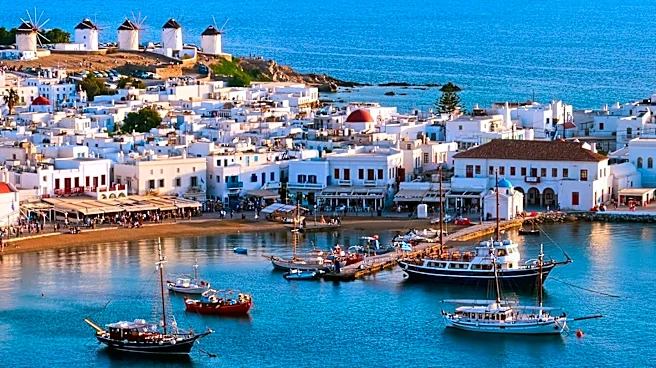



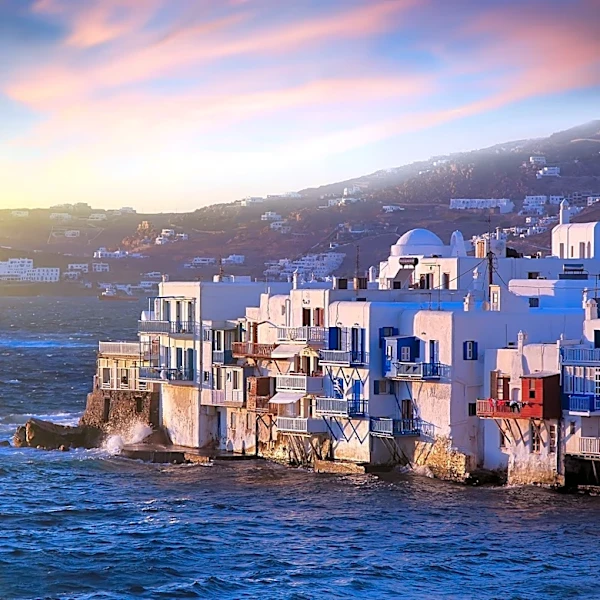


Mykonos, a Greek island nestled within the Cyclades, boasts a rich and complex history that has shaped its identity from ancient times to its modern status as a global tourist destination. Known as "The Island of the Winds" due to its strong breezes, Mykonos has witnessed the rise and fall of empires, endured periods of prosperity and decline, and played a significant role in pivotal historical events. Its strategic location in the Aegean Sea, between
Tinos, Syros, Paros, and Naxos, has often placed it at the crossroads of various civilizations and conflicts.
Early Inhabitants and Ancient Significance
According to historical accounts, the Carians were the original inhabitants of Mykonos. They were later followed by Ionians from Athens in the early 11th century BC. While Mykonos itself was considered a rather poor island with limited agricultural resources during ancient times, its proximity to Delos, a mere 1.2 miles away, made it an important hub. Delos served as the meeting ground for the Delian League, and Mykonos became a crucial location for supplies and transit for the many people living on the neighboring island. The inhabitants of Mykonos during this period were polytheists, worshiping a multitude of gods.Following the death of Alexander the Great, Mykonos became a member of the League of the Islanders during the Hellenistic period. Its political landscape shifted again as it came under the control of the Romans, and subsequently became part of the vast Byzantine Empire, a status it maintained until the 12th century. These early periods laid the groundwork for the island's future, establishing its place within the broader Mediterranean world.
Venetian Rule and Ottoman Influence
The fall of Constantinople during the Fourth Crusade in 1204 marked a new chapter for Mykonos, as it was occupied by Andrea Ghisi. The island faced further turmoil at the end of the 13th century when it was ravaged by the Catalans. Eventually, Mykonos transitioned to direct Venetian rule in 1390, a period that would significantly influence its culture and architecture, elements of which can still be seen today.However, Venetian control was not absolute or permanent. In 1537, while still under Venetian dominion, Mykonos was attacked by Hayreddin Barbarossa, the admiral of Suleiman the Magnificent. An Ottoman fleet established itself on the island, leading to Mykonos becoming part of the Ottoman Empire. This Ottoman rule lasted for nearly three centuries, from 1537 to 1830, during which time the island was also known by its Turkish name, "Mukene." The Ottomans implemented a system of self-governance, led by a governor and an appointed council of syndics. The final withdrawal of the Venetians from the region occurred in 1718, after the castle of neighboring Tinos fell to the Ottomans.
Prosperity, Revolution, and Modern Challenges
Up until the close of the 18th century, Mykonos experienced a period of prosperity, thriving as a trading center. This economic success attracted numerous immigrants from nearby islands, though it also made the island a target for regular pirate raids. A notable event during this era was the Battle of Mykonos in June 1794, fought between British and French ships in the island's main harbor.Mykonos played a significant role in the Greek Revolution against the Ottoman Empire, which began in 1821. The national heroine, Manto Mavrogenous, an educated aristocrat influenced by Enlightenment ideals, famously sacrificed her family's fortune to support the Greek cause. A statue of her now stands in Manto Mavrogenous Square in the main town, commemorating her contributions. Greece achieved independence in 1830, and Mykonos, like the rest of the nation, embarked on a new path.
The island's economy quickly recovered due to sailing and merchant activity, but faced another decline in the late 19th century, exacerbated by the opening of the Corinth Canal in 1904 and the First World War. This led many Mykonians to seek work in mainland Greece and abroad, particularly in the United States. During World War II, in September 1944, the Greek Sacred Squadron conducted a commando raid against the German garrison on Mykonos, inflicting casualties and destroying supplies. The remaining German troops surrendered, and Mykonos was liberated on September 30, 1944. In the post-war era, tourism emerged as the dominant industry, significantly boosted by archaeological excavations on Delos and the island's growing popularity with the international "jet set" in the 1960s, evolving into a renowned destination for its vibrant nightlife, beaches, and traditional Cycladic architecture.