


The Battle of Missionary Ridge, fought on November 25, 1863, in Chattanooga, Tennessee, marked a pivotal moment in the American Civil War's Chattanooga campaign. This engagement saw Union forces, led by Major Generals Ulysses S. Grant, William T. Sherman, and George H. Thomas, decisively defeat Confederate forces under General Braxton Bragg. The Union victory was crucial, as it successfully ended the Confederate siege of Union troops in Chattanooga, a strategic
location in the conflict. The battle's plan involved a multi-pronged attack, with Sherman targeting the northern end of Missionary Ridge and divisions under Major General Joseph Hooker advancing from the southern end, ultimately routing Bragg's army.
Strategic Context and Confederate Weaknesses
Leading up to the battle, Confederate General Braxton Bragg had inadvertently weakened his forces, a factor that would contribute to the Union's success. On November 5, Bragg dispatched Lieutenant General James Longstreet's Corps, which included the divisions of Major General Lafayette McLaws and Brigadier General Micah Jenkins, to confront Major General Ambrose Burnside near Knoxville. This move significantly reduced Bragg's available manpower. Further compounding this issue, on November 22, Bragg ordered Buckner's division to reinforce Longstreet in Knoxville, further depleting his strength at Missionary Ridge. These decisions left the Confederate defenses more vulnerable than they might have been.
Sherman arrived with his 20,000 men from the Army of the Tennessee in mid-November, bolstering the Union's offensive capabilities. The Union command, consisting of Grant, Sherman, and Thomas, devised a flanking strategy. Sherman was tasked with assaulting the northern end of Missionary Ridge, supported by two of Thomas's divisions from the center. Initially, Hooker's role was limited to diverting Bragg's attention through demonstrations on Lookout Mountain, which the Confederates had already evacuated. However, Thomas later requested Hooker's support on his flank, leading Hooker to cross the valley and demonstrate against Bragg's left flank directly at the Rossville Gap.
Sherman's Assault and Unexpected Challenges
Grant's primary plan for November 25 centered on Sherman's attack against Bragg's right flank at Tunnel Hill. Thomas was assigned a supporting role, instructed to advance at first light and either capture the rifle pits and ridge directly in front of his position or move to the left as the enemy's presence dictated. Sherman's objective was to quickly secure a position on the extremity of Missionary Ridge, threatening the Confederate depot at Chickamauga Station and forcing Bragg to either dislodge him or risk losing the depot. Sherman anticipated a Confederate counterattack at dawn, but when it didn't materialize, Grant ordered him to take the offensive to relieve pressure on Burnside in East Tennessee.
Despite the strategic importance of his mission, Sherman's attack faced significant difficulties and was ultimately deemed a tactical failure. He committed only a fraction of his available force in a direct assault on a strong position, rather than attempting to outflank Bragg. Military historian David Eicher characterized this as Sherman's "worst experience as a commander," citing miscalculations of terrain and a prolonged, unsuccessful, and needless attack. Conversely, Steven E. Woodworth praised Confederate General Cleburne's performance, noting his skillful troop movements and timely counterattacks. Sherman's forces, consisting of about 16,600 men from three divisions and additional regiments, were initially opposed by just three small brigades under Cleburne, totaling about 4,000 men, with only the Texas brigade positioned on Tunnel Hill. Sherman, seemingly unnerved by his incorrect positioning, delayed his attack until around 9:00 AM, selecting only two brigades from Ewing's division to lead the assault. Brigadier General John M. Corse approached from the north, while Colonel John M. Loomis advanced from the northwest across open fields. Corse initially drove off the Confederate skirmish line and seized some defensive works but was repulsed when he charged Cleburne's main position. After several attempts, Sherman abandoned the attack from Corse's position, shifting the fighting to the west side of the ridge. Loomis skirmished with Walker's division, and additional Union brigades were sent up the west slope of Tunnel Hill. Cleburne's salient came under pressure, but Hardee reinforced him, and Cleburne ordered a general counterattack at 4:00 PM, routing Sherman's tired and low-on-ammunition men and capturing numerous Federal prisoners. Sherman's attack resulted in almost 2,000 casualties.
Thomas's Breakthrough and the Confederate Collapse
While Sherman struggled, the Union center, under Major General George H. Thomas, achieved a dramatic and unexpected breakthrough. Around 2:30 PM, Grant, observing Sherman's difficulties, suggested to Thomas that they should assist him by sending divisions against the Confederate rifle pits at the base of the ridge, hoping to distract Bragg. Thomas, however, was hesitant, preferring to wait until Hooker's flank attack was confirmed. Grant, growing impatient, eventually ordered Thomas to instruct Major General Gordon Granger to advance and take the enemy's first line of rifle pits. After some initial reluctance from Granger, the order was finally issued at 3:00 PM to Brigadier General Thomas J. Wood's and Major General Philip Sheridan's divisions, with additional orders sent to Brigadier Generals Absalom Baird and Richard W. Johnson of Major General John M. Palmer's XIV Corps to move upon hearing a signal of six artillery pieces.
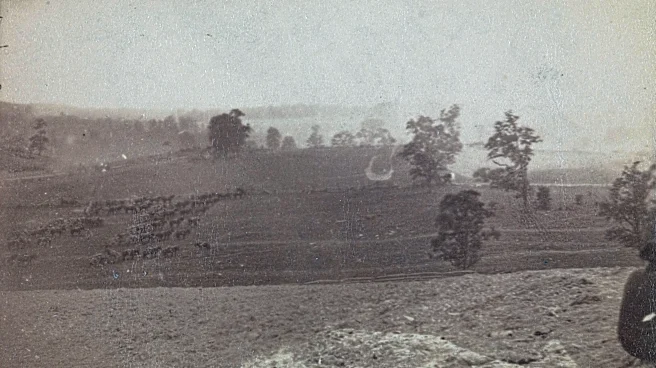
Thomas deployed 23,000 men in four divisions, with brigades in line, facing approximately 20,000 Confederates defending the center of the ridge. Around 3:40 PM, the signal guns fired, initiating the assault. The 9,000 Confederates in the rifle pits at the base of the ridge were plagued by conflicting orders, with some told to retreat after a volley and others to hold their ground. The Union charge, with men shouting "Chickamauga! Chickamauga!", overwhelmed the Confederate defenders, many of whom were captured or fled up the steep 300- to 400-foot climb to the ridge top. The 100 Confederate cannons on the ridge initially struggled to hit the rushing Union troops but began to zero in once the Union soldiers halted at the rifle pits. Confederate riflemen also inflicted casualties. Union unit commanders, realizing the danger of remaining in the rifle pits, began moving their men forward. Brigadier General August Willich's skirmishers advanced without orders, and Willich, deciding that following them was preferable to being massacred, ordered a general advance. Hazen and Beatty followed suit, and Wood sent his second line forward. Grant was shocked to see his troops climbing the ridge, and when he asked who gave the order, neither Thomas nor Granger claimed responsibility, with Granger famously remarking, "When those fellows get started, all hell can't stop them." The Union advance continued, with various brigades pushing up the ridge, despite some confusion regarding orders. The Confederate line first broke at Bird's Mill Road around 5:00 PM, as Union troops, protected by a roll of ground, surprised and overwhelmed a Confederate brigade. The lack of a tactical reserve and the narrow ridgetop meant Bragg's defenses were a thin crust. As Union troops flanked Confederate positions, the Southern generals were forced to pull regiments from their main line, further weakening their defense. By 6:00 PM, the center of Bragg's line had completely broken, leading to a panicked flight and the abandonment of Missionary Ridge. Only Cleburne's command, augmented by two brigades, remained intact and formed the rear guard for Bragg's retreat eastward to South Chickamauga Creek. Sheridan attempted a pursuit but eventually gave up when he realized he lacked support from Granger or Thomas. The Army of the Cumberland's ascent of Missionary Ridge is remembered as one of the war's most dramatic events, with military historians Herman Hattaway and Archer Jones calling it "the war's most notable example of a frontal assault succeeding against entrenched defenders holding high ground."