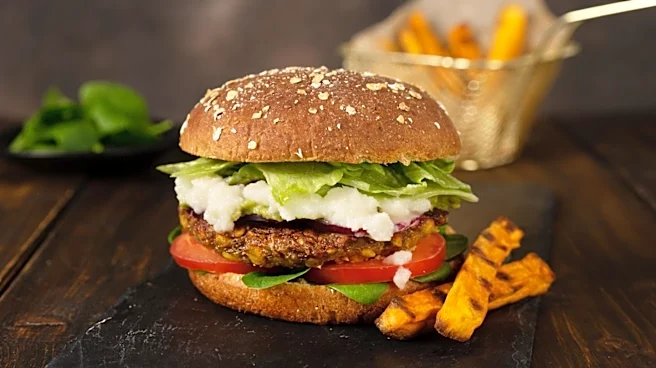









The hamburger, a seemingly simple dish of ground meat placed inside a bun, has evolved from contentious origins into a global culinary icon. While its exact birthplace remains a subject of debate, the hamburger's journey from a regional specialty to a staple of fast food and a symbol of American culture is undeniable. Its adaptability and widespread appeal have allowed it to transcend borders, leading to numerous international and regional variations
that cater to diverse palates.
Tracing the Elusive Origins of the Hamburger
The precise invention of the hamburger is a topic of much discussion, with various individuals and locations laying claim to its creation. One of the earliest references to a "Hamburg steak" appeared in The Boston Journal in 1884. Further back, the 1758 edition of Hannah Glasse's "The Art of Cookery Made Plain and Easy" included a recipe for "Hamburgh sausage," suggesting it be served roasted with toasted bread. This indicates that the concept of ground meat served with bread has a long history, predating the modern hamburger.
Several American figures are credited with inventing the hamburger in the late 19th century. Fletcher Davis of Athens, Texas, is said to have opened a lunch counter in the 1880s, serving fried ground beef patties with mustard and Bermuda onion between two slices of bread. He and his wife reportedly ran a sandwich stand at the 1904 St. Louis World's Fair, where the New York Tribune referred to the hamburger as "the innovation of a food vendor on the pike," suggesting it gained national recognition there. Frank and Charles Menches claim to have sold a ground beef sandwich at the Erie County Fair in Hamburg, New York, in 1885, substituting beef when they ran out of pork sausage. The family of Oscar Weber Bilby claims the first-known hamburger on a bun was served on July 4, 1891, on Grandpa Oscar's farm in Tulsa, Oklahoma, a claim later proclaimed by Governor Frank Keating. Charlie Nagreen, also known as "Hamburger Charlie," reportedly sold meatballs between two slices of bread at the Seymour Fair in 1885, naming it after the Hamburg steak familiar to local German immigrants. Louis Lassen of Louis' Lunch in New Haven, Connecticut, founded in 1895, claims that around 1900, he put grilled ground beef trimmings between two slices of toast for a customer, though some critics argue this wasn't a true hamburger due to the toasted bread.
The Hamburger's Rise to Global Prominence
Despite its contested origins, the hamburger's popularity soared, particularly in the United States, eventually becoming a global phenomenon. Major multinational fast-food chains like McDonald's and Burger King have played a significant role in this expansion, with their signature burgers becoming global icons of American culture. These establishments have made hamburgers staples of fast food, typically served with french fries, and have introduced the dish to countless countries worldwide.
The term "burger" itself has evolved, becoming a standalone word associated with various sandwiches containing different meats or meat substitutes. This linguistic rebracketing allows for creations like buffalo burgers, venison burgers, chicken burgers, turkey burgers, salmon burgers, and even veggie burgers. For clarity, the type of meat or substitute is often prefixed, as in "beef burger" or "portobello burger." This demonstrates the hamburger's versatility and its ability to adapt to different dietary preferences and cultural contexts, further solidifying its global presence.
International Adaptations and Cultural Interpretations
The hamburger's global journey has led to fascinating regional and international variations. In Australia and New Zealand, traditional hamburgers often include sliced beetroot, and a "burger with the lot" can feature cheese, pineapple, a fried egg, and bacon. Unlike in American English, burgers in these countries are generally not considered sandwiches. Denmark introduced the "bøfsandwich" in 1949, which has evolved to include a beef patty, pickled cucumber, various onions, pickled red beets, mustard, ketchup, remoulade, and often brown gravy. In China, the term "burger" refers to any sandwich with two pieces of bun and a meat patty, with the popular street food "roujiamo" being called the "Chinese hamburger."
India, due to cultural beliefs against eating beef and pork, features burgers made from chicken or vegetable patties, with McDonald's offering the "Maharaja Mac" with chicken instead of beef. The "vada pav," a deep-fried potato patty, is sometimes called the "Bombay burger." In Pakistan, the "shami burger" is made from "shami kebab," a mix of lentils and minced lamb. Turkey offers unique variations like the "Islak Burger," a beef slider doused in seasoned tomato sauce and steamed. These diverse adaptations highlight how the hamburger has been embraced and reinterpreted across different cultures, demonstrating its universal appeal and its capacity to integrate into local culinary traditions while maintaining its fundamental identity as a ground meat patty in a bun.