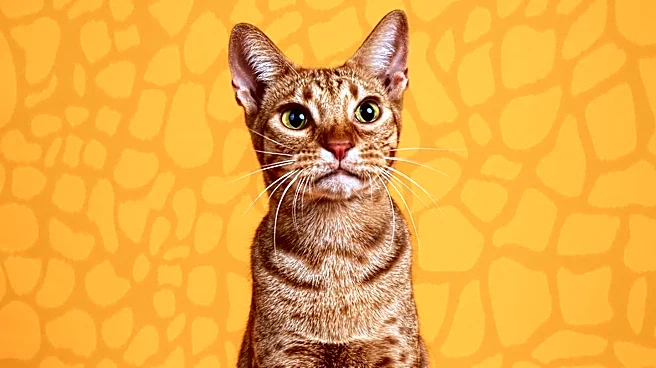






The Ocicat is a fascinating domestic cat breed that captivates with its wild-cat-like appearance, yet it possesses no recent wild DNA in its genetic makeup. This breed is entirely domestic, a testament to selective breeding that has resulted in a spotted tabby coat reminiscent of its namesake, the ocelot. Originating in the United States, the Ocicat has gained recognition from various cat fancier organizations, celebrated for its distinctive look
and its slightly larger size compared to typical domestic cats. Its unique combination of a wild aesthetic and a purely domestic heritage makes it a remarkable example of feline breeding.
The Genesis of a Spotted Companion
The Ocicat's journey began in 1964, thanks to the spontaneous efforts of Virginia Daly of Berkley, Michigan. Daly embarked on a breeding program with the goal of combining the reddish-brown ticked tabby agouti pattern of a black Abyssinian with the oriental build and colorpoint pattern of a Siamese. Her initial cross involved a black ('ruddy') ticked tabby Abyssinian male, who carried the cinnamon gene, named Dalai Deta Tim of Selene, and a female black ('seal') point Siamese named Dalai Tomboy Patter. The first generation of kittens from this pairing largely resembled Abyssinians.
One of these Abyssinian-like females, Dalai She, was kept and later bred with a chocolate point Siamese tom named Whitehead Elegante Sun. This subsequent litter produced the desired mixed Abyssinian-Siamese-style kittens. However, it was in this litter that a truly unexpected and pivotal development occurred: one kitten emerged with cinnamon-colored spots set against an ivory background. This spotted kitten immediately drew attention, with Virginia's daughter remarking on its resemblance to an ocelot and suggesting the name 'ocicat.' Although this particular kitten, named Tonga, was sold to a medical student with an agreement for neutering, its unique spotting sparked a new direction for Daly's breeding program.
Refining the Wild Look: The Role of American Shorthair
The appearance of Tonga, the spotted kitten, caught the eye of geneticist Dr. Clyde Keeler of Georgia University, with whom Daly corresponded. Keeler, who was interested in creating a spotted cat similar to extinct Egyptian felines, noted Tonga's resemblance to such cats. Despite Tonga being neutered, Keeler's suggestion to breed Tonga back with his mother inspired Daly to repeat the original pairing of Tonga's parents. This led to the birth of Dalai Dotson, a black ('tawny') spotted male, which solidified Daly's focus on developing this spotted tabby, wild-appearing cat.
To further enhance the breed, a crucial step involved incorporating the American Shorthair into the breeding program. The introduction of the American Shorthair served multiple purposes. It was intended to improve the Ocicat's body structure and bone density, contributing to a more robust physique. Additionally, the American Shorthair brought with it the gene for silver coloring, expanding the range of coat colors available within the Ocicat breed. This careful selection and crossbreeding ultimately led to the Ocicat as it is known today, a domestic cat with a striking wild appearance, available in twelve fur coat colors, including various shades of silver.