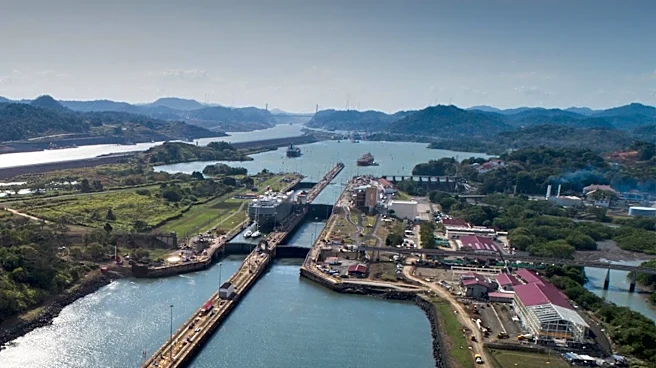


The story of the Panama Canal is deeply intertwined with international ambition, engineering challenges, and political maneuvering that culminated in the Hay–Bunau-Varilla Treaty of 1903. Before the United States took on the monumental task of building the canal, a French effort, led by Ferdinand de Lesseps, the builder of the Suez Canal, had already attempted to traverse the Isthmus of Panama. This initial endeavor, beginning in 1882, faced immense
engineering hurdles, including frequent landslides, equipment failures, and widespread disease, ultimately leading to bankruptcy by 1889. The failure of the French project left behind valuable concessions and assets, which would later become central to American plans.
The French Legacy and U.S. Strategic Interests
Following the collapse of de Lesseps' company, Philippe-Jean Bunau-Varilla emerged as a significant shareholder in the Compagnie Nouvelle du Canal de Panama, which still held the concession and assets for a canal in Panama. Meanwhile, the United States harbored growing strategic interests in the region, particularly concerning the construction and control of an interoceanic canal. The Spanish-American War of 1898 underscored the military necessity of such a waterway, as U.S. warships had to undertake a lengthy voyage around South America to move between the Atlantic and Pacific fleets. This strategic imperative fueled American determination to build a canal, initially considering routes through Nicaragua before settling on Panama.
President Theodore Roosevelt, a strong advocate for American naval power, was convinced of the canal's importance. His administration initially pursued negotiations with Colombia, which controlled Panama at the time. The Hay–Herrán Treaty, negotiated in early 1903, aimed to secure U.S. control over the canal zone and included the purchase of the French-held land for $40 million. However, the Colombian Congress rejected this treaty on August 12, 1903, creating a significant obstacle for U.S. plans and putting the French investors, including Bunau-Varilla, at risk of losing their investments.
The Spark of Panamanian Independence
The rejection of the Hay–Herrán Treaty by Colombia proved to be a critical turning point. It galvanized Bunau-Varilla, who, confident in President Roosevelt's support, met with Manuel Amador, a key figure in the Panamanian independence movement. In a New York hotel suite, Bunau-Varilla provided Amador with $100,000 to fund a renewed Panamanian revolt against Colombian rule. In return, Bunau-Varilla was promised the role of Panama's representative in Washington, D.C.
With this financial backing and the tacit support of the United States, Panama proclaimed its independence in November 1903. The U.S. quickly recognized the new Republic of Panama on November 13. Despite not having been in Panama for seventeen years and never returning, Bunau-Varilla was promptly appointed as Panama's ambassador to the United States. This swift appointment allowed him to immediately engage in negotiations with U.S. Secretary of State John Hay, leading to the Hay–Bunau-Varilla Treaty just five days after Panama's formal recognition by the U.S.
The Treaty's Immediate Aftermath and Legacy
The Hay–Bunau-Varilla Treaty, signed on November 18, 1903, formally established the Panama Canal Zone and granted the United States extensive rights for the canal's construction and administration. The U.S. purchased the French company's assets for $40 million, as originally planned. While the treaty secured the American objective of building the canal, it was met with immediate condemnation by many Panamanians who viewed it as an infringement on their new nation's sovereignty. The leaders of the nascent Panamanian government felt pressured to accept the terms, fearing that a rejection would lead to the withdrawal of U.S. protection and a potential reassertion of Colombian control.
This complex series of events—from failed French ventures to U.S. strategic interests, Colombian political resistance, and a U.S.-backed Panamanian independence movement—ultimately shaped the geopolitical landscape of Central America and enabled the construction of one of the world's most vital waterways. The treaty, born out of this intricate background, would define U.S.-Panamanian relations for decades and remain a symbol of American influence in the region.