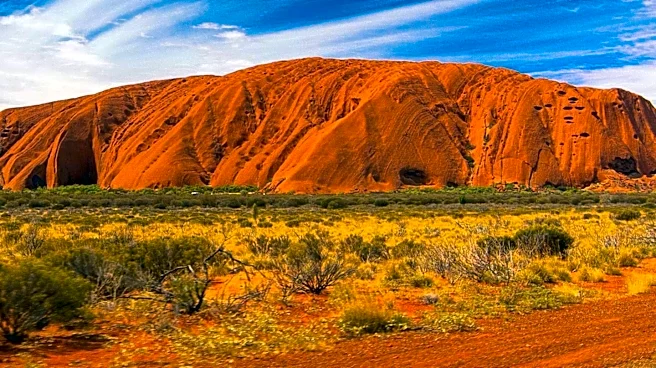

Uluru, also known as Ayers Rock, stands as a prominent sandstone monolith in Australia's Northern Territory. This iconic natural formation is not only one of Australia's most recognizable landmarks but
also holds immense sacred value for the Pitjantjatjara, the Aboriginal people of the area known as the Anangu. Its striking appearance, particularly its color changes at dawn and sunset, has captivated visitors for decades, making it a popular tourist destination since the late 1930s. Beyond its visual appeal, Uluru is a UNESCO World Heritage Site, recognized for both its natural and cultural significance.
Geological Marvel and Unique Composition
Uluru is a massive sandstone monolith, rising 348 meters (1,142 ft) high and reaching 863 meters (2,831 ft) above sea level. A significant portion of its bulk lies underground, contributing to its impressive scale. The formation has a total perimeter of 9.4 kilometers (5.8 mi). Its distinctive reddish color is attributed to iron oxide present in the sandstone, which becomes particularly vibrant during sunrise and sunset, creating a glowing red effect. This geological feature is dominantly composed of coarse-grained arkose, a type of sandstone rich in feldspar, along with some conglomerate.The average composition of Uluru's rock includes about 50% feldspar, 25–35% quartz, and up to 25% rock fragments. Most of the feldspar is K-feldspar, with only minor amounts of plagioclase appearing as subrounded grains and altered inclusions within the K-feldspar. The grains typically measure 2–4 mm (0.08–0.16 in) in diameter and are angular to subangular. While the finer sandstone is well sorted, the sorting decreases as grain size increases. The rock fragments found within Uluru include subrounded basalt, which has been replaced to varying degrees by chlorite and epidote. The minerals present in Uluru suggest that its origin is primarily from a granite source.
Sacred Site and Ancestral Stories
For the Anangu people, Uluru is far more than just a rock; it is a sacred place deeply intertwined with their culture and ancestral beliefs. The area surrounding Uluru is rich with springs, waterholes, rock caves, and ancient paintings, all of which contribute to its spiritual importance. The Anangu, who are the traditional owners of Uluru-Kata Tjuta National Park, believe their culture was created at the beginning of time by ancestral beings. Uluru and the nearby Kata Tjuta provide physical evidence of the feats performed during this creation period.Many stories from The Dreaming, dating back thousands of years, are associated with Uluru. According to the Anangu, the world was once a featureless place until creator beings, in the forms of people, plants, and animals, traveled widely across the land. Through a process of creation and destruction, they formed the landscape as it is known today. Anangu land is still inhabited by the spirits of dozens of these ancestral creator beings, referred to as Tjukuritja or Waparitja. These ancestral beings interacted with the landscape, and some are believed to still reside there, making Uluru a living testament to their ancient traditions.
Cultural Significance and Modern Recognition
Uluru's cultural significance extends to its role in informing visitors about the bush, food, local flora and fauna, and Aboriginal Dreamtime stories. The Anangu often lead walking tours to share this knowledge, reinforcing the deep connection between the people and the land. The name "Uluru" itself is a proper noun in the Pitjantjatjara dialect, used as a local family name by the senior traditional owners, and it carries no further particular meaning beyond that. However, it is now officially recognized alongside Ayers Rock, reflecting a growing acknowledgment of its indigenous heritage.The site's importance is further highlighted by its listing as a UNESCO World Heritage Site for both natural and cultural landscape in 1987. This recognition underscores its global value, not just as a geological wonder but as a repository of ancient culture and spirituality. Uluru, along with Kata Tjuta, forms the two major features of the Uluru-Kata Tjuta National Park, a protected area that covers 1,326 square kilometers (512 sq mi). The park's management involves a joint effort between Parks Australia and the Aboriginal traditional land owners, the Anangu people, a process known as 'joint management' that began after the traditional owners were presented with the freehold title deeds for the park in 1985 and subsequently leased the land back to the Australian Government for 99 years.