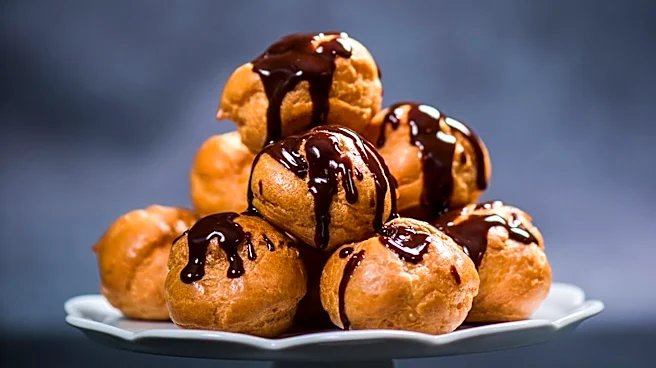





The profiterole, a beloved sweet pastry known today for its cream or ice cream filling and chocolate topping, boasts a surprisingly diverse and lengthy history. Originating in France, its culinary journey spans centuries, transforming from a savory component in elaborate dishes and soups to the sweet confection we recognize. This evolution highlights shifts in culinary trends and the ingenuity of French patissiers who adapted and refined this versatile
creation over time.
Early Savory Beginnings in the 17th Century
The earliest documented forms of profiteroles in the 17th century were far removed from their modern sweet counterparts. During this period, profiteroles were described as small, hollow bread rolls. These rolls were not filled with cream or ice cream, but rather with a rich and complex mixture of savory ingredients. Common fillings included sweetbreads, truffles, artichoke bottoms, and mushrooms. They could also contain pieces of various poultry, such as partridge or pheasant, often accompanied by other garnishes. These savory profiteroles were versatile enough to be served not only as a dish on their own but also as an element in soups, indicating their role as a substantial and flavorful component of meals.François Massialot, in his 1698 work *Le Cuisinier royal et bourgeois*, provided several recipes for profiterole soup. These recipes detailed fillings of minced ham and poultry, served on a stew that included mushrooms, asparagus, artichoke bottoms, rooster crests, sweetbreads, and truffles. This demonstrates the elaborate nature of these early savory preparations, where the profiterole acted as a vessel for a rich ragout. Other culinary writers of the era, such as Joseph Menon in his 1732 *Traité de cuisine* and François Marin in *Les Dons de Comus* (1750), also offered examples of savory profiterole recipes, maintaining the core principle of a filled, hollow bread item.
The Transition to Sweetness in the 19th Century
The sweet profiteroles familiar today began to emerge in the early 19th century. While the exact moment of transition is not precisely pinpointed, culinary texts from this period show a clear shift towards sweet preparations. Antoine Beauvilliers, in his 1816 book *L’Art du cuisinier*, included a recipe for chocolate profiteroles, marking an important step in their sweet evolution. Marie-Antoine Carême, a highly influential chef, further contributed to this transformation. In his 1828 *Le Cuisinier royal parisien*, Carême also presented a recipe for chocolate profiteroles. His work is noted for translating earlier savory recipes into sweet ones, even maintaining similar arrangements and quantities in the dish.Carême's inspiration for these sweet versions reportedly came from earlier chefs like François Massialot, whose works he adapted. This period also saw the development of choux pastry, the key ingredient for modern profiteroles. While a legend attributes choux pastry to Catherine de' Medici's chef, this is considered a 19th-century invention. The art of choux pastry began developing around the 17th century, with patissier Jean Avice further refining it in the mid-18th century to create choux buns. Antoine Carême himself developed the choux pastry recipe commonly used today, solidifying the foundation for the sweet profiterole. By 1870, Jules Gouffé, in his *Livre de cuisine*, explicitly defined a profiterole as a small choux pastry, confirming its established sweet identity.
Modern Interpretations and Global Reach
By the late 19th century, the sweet profiterole had largely taken its modern form. Gustave Garlin, in *Le Cuisinier moderne* (1887), described profiteroles filled with cream and glazed with chocolate or coffee, noting the desire for a smooth and shiny finish. Joseph Favre, in his 1888 *Dictionnaire universel de cuisine*, explained that profiteroles were made with choux pastry and could be filled with either sweet preparations or savory purees of game or poultry, though the sweet version was becoming dominant. Today, profiteroles are commonly filled with vanilla ice cream, often accompanied by whipped cream and frequently topped with chocolate sauce.The dessert's popularity extended beyond France. In Louisiana, the recipe for profiteroles was reportedly introduced over two centuries ago. Due to the hot climate, which made using traditional pastry cream challenging as milk would spoil quickly, ice cream became the customary filling. Louisianan recipes often feature vanilla or chocolate ice cream, sometimes with caramel sauce or chocolate ganache. This adaptation highlights how the profiterole, while rooted in French tradition, has evolved and been embraced in various culinary contexts, maintaining its core identity as a delightful, filled choux pastry.