




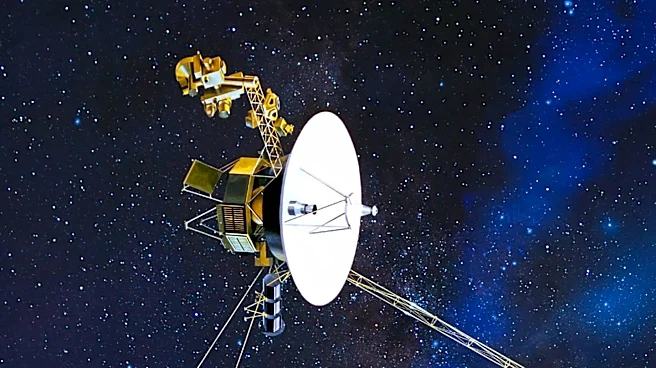
The Parker Solar Probe, launched by NASA in 2018, represents a significant leap in our ability to study the Sun. This spacecraft is designed to explore the Sun's outer corona, a region that has long intrigued scientists due to its complex and dynamic nature. By venturing closer to the Sun than any previous mission, the Parker Solar Probe aims to provide unprecedented insights into solar phenomena.
The Launch and Objectives
The Parker Solar Probe was launched on August 12, 2018,
from Cape Canaveral, Florida, aboard a Delta IV Heavy rocket. Its primary mission is to study the Sun's outer corona, a region that is crucial for understanding solar wind and other solar activities. The spacecraft is equipped with a suite of instruments designed to capture detailed images and data, allowing scientists to analyze the Sun's behavior more closely than ever before.
One of the key objectives of the Parker Solar Probe is to understand the structure and dynamics of the solar corona. By getting within 6.9 million kilometers of the Sun's surface, the probe can observe solar phenomena such as coronal streamers, plumes, and mass ejections. These observations are expected to shed light on the processes that drive solar wind and influence space weather, which can have significant impacts on Earth.
Instruments and Capabilities
Central to the Parker Solar Probe's mission is its suite of scientific instruments, including the Wide-Field Imager for Solar Probe (WISPR). Developed by the U.S. Naval Research Laboratory, WISPR is designed to capture visible light images of the solar corona and other solar phenomena. The instrument's field of view extends from 13 to 108 degrees away from the Sun, allowing it to capture a wide range of solar activities without directly imaging the Sun itself.
WISPR consists of two telescopes, WISPR-Inner and WISPR-Outer, each equipped with radiation-hardened CMOS sensors. These sensors are capable of capturing high-resolution images at both visible and near-infrared wavelengths. By analyzing these images, scientists can study the electron density and velocity structure of the corona, providing valuable insights into the Sun's behavior.
Achievements and Discoveries
Since its launch, the Parker Solar Probe has made several significant contributions to our understanding of the Sun. In September 2018, the first light image from WISPR was published, showcasing the instrument's capabilities. Later that year, the probe captured a view of the corona, including a coronal streamer, providing new perspectives on solar structures.
In November 2018, the Parker Solar Probe recorded solar wind during its first close pass to the Sun. This data has revealed details about solar structures and processes that were previously unseen, offering new opportunities for scientific discovery. As the probe continues its mission, it is expected to provide even more groundbreaking insights into the Sun's mysteries.