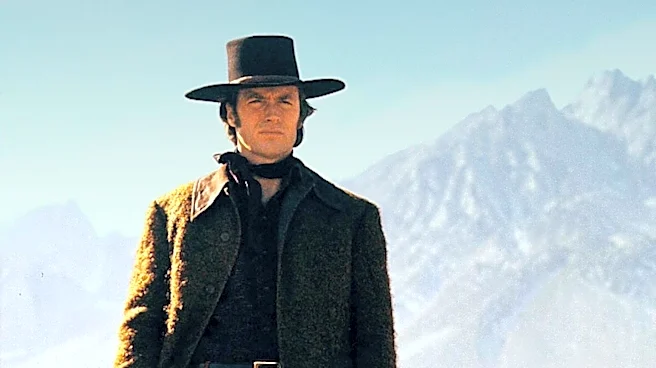





*A Fistful of Dollars*, released in 1964 in Italy, marked the beginning of the iconic Dollars Trilogy, directed by Sergio Leone. This film, which would later become a cornerstone of the Spaghetti Western genre, was produced with a budget estimated between $200,000 and $225,000. It was a collaborative effort involving Italy, Spain, and West Germany, and was filmed in English. The movie's narrative centers on an unnamed stranger who arrives in the town
of San Miguel, caught in a violent feud between two smuggling families, the Rojos and the Baxters. The stranger, often referred to as "the Man with No Name," strategically plays these families against each other for his own gain, demonstrating his deadly skills early on by dispatching four men who insulted him.
Unofficial Remake and Legal Ramifications
The film's plot, involving a protagonist who manipulates two warring factions, bore a striking resemblance to Akira Kurosawa's 1961 film *Yojimbo*. Kurosawa himself noted the similarity, stating that Leone had made "a fine movie, but it was my movie." This strong resemblance led to a significant legal dispute. Toho, the production company behind *Yojimbo*, initiated a lawsuit against Leone. Initially, Leone reportedly ignored the lawsuit, but eventually, an out-of-court settlement was reached. This settlement was substantial, reportedly granting Toho 15% of the worldwide receipts from *A Fistful of Dollars* and an additional sum exceeding $100,000.
Leone, in his defense, cited alternative sources for the film's thematic inspiration. He claimed a thematic debt to Carlo Goldoni's 18th-century play *Servant of Two Masters*, which features a protagonist who plays two camps against each other. Leone asserted that this connection rooted the origination of *A Fistful of Dollars* and *Yojimbo* in European, specifically Italian, culture. He also suggested that the plot of *The Servant of Two Masters* could be seen in Dashiell Hammett's 1929 novel *Red Harvest*, whose protagonist, the Continental Op, is notably a man without a name. Leone believed that *Red Harvest* had influenced *Yojimbo*, stating, "Kurosawa's *Yojimbo* was inspired by an American novel of the series-noire so I was really taking the story back home again." He also referenced numerous American Westerns, such as *Shane* and *My Darling Clementine*, as influences, noting that these differed from *Yojimbo*.
Plot Development and Character Dynamics
The stranger's plan unfolds as he witnesses the Rojos massacre Mexican soldiers escorting gold. He uses two dead bodies to create a ruse, propping them up in a cemetery to appear alive. He then sells information to both the Baxters and the Rojos, claiming two soldiers survived. This leads to a gunfight between the families, allowing the stranger to search the Rojo hacienda for gold. During this search, he accidentally knocks out Marisol, a woman held captive by Ramón Rojo, with whom Ramón is in love. The stranger takes Marisol to the Baxters, who arrange to exchange her for their son, Antonio, captured by the Rojos.
The hostage exchange is interrupted by Marisol's son, Jesus, and husband, Julio. Ramón orders one of his men to kill Julio, but Silvanito and the stranger intervene. The stranger learns from Silvanito that Ramón took Marisol as collateral after accusing Julio of cheating in a card game. That night, the stranger kills guards, frees Marisol, and damages her holding house to make it appear as a Baxter attack. He gives Marisol money and urges her family to leave town. The Rojos eventually discover the stranger's involvement, capture and torture him, but he escapes. Believing the Baxters protected him, the Rojos burn the Baxter home, massacring everyone. With the help of the coffinmaker Piripero, the stranger escapes town in a coffin and recuperates in an abandoned mine. Upon learning Silvanito was captured and tortured for his whereabouts, the stranger returns to confront the Rojos, ultimately defeating Ramón in a duel and freeing Silvanito, before riding away from the now-peaceful town.
Digital Restoration for a New Generation
Decades after its initial release, *A Fistful of Dollars* underwent a significant digital restoration. In 2014, Cineteca di Bologna and Unidis Jolly Film collaborated on a digital restoration for the film's Blu-ray debut and its 50th anniversary. Prasad Corporation performed a frame-by-frame digital restoration, meticulously removing dirt, tears, scratches, and other defects from the film. The restored version retained the directorial credit for Leone, which had replaced the earlier "Bob Robertson" card years prior. However, the original credits, including pseudonyms like "Dan Savio" for composer Ennio Morricone, were preserved, maintaining the film's historical integrity while enhancing its visual quality for modern audiences.